The EU AI Act: A Compliance Guide for Business Leaders
The EU AI Act is already in force, and enforcement begins in August 2026.
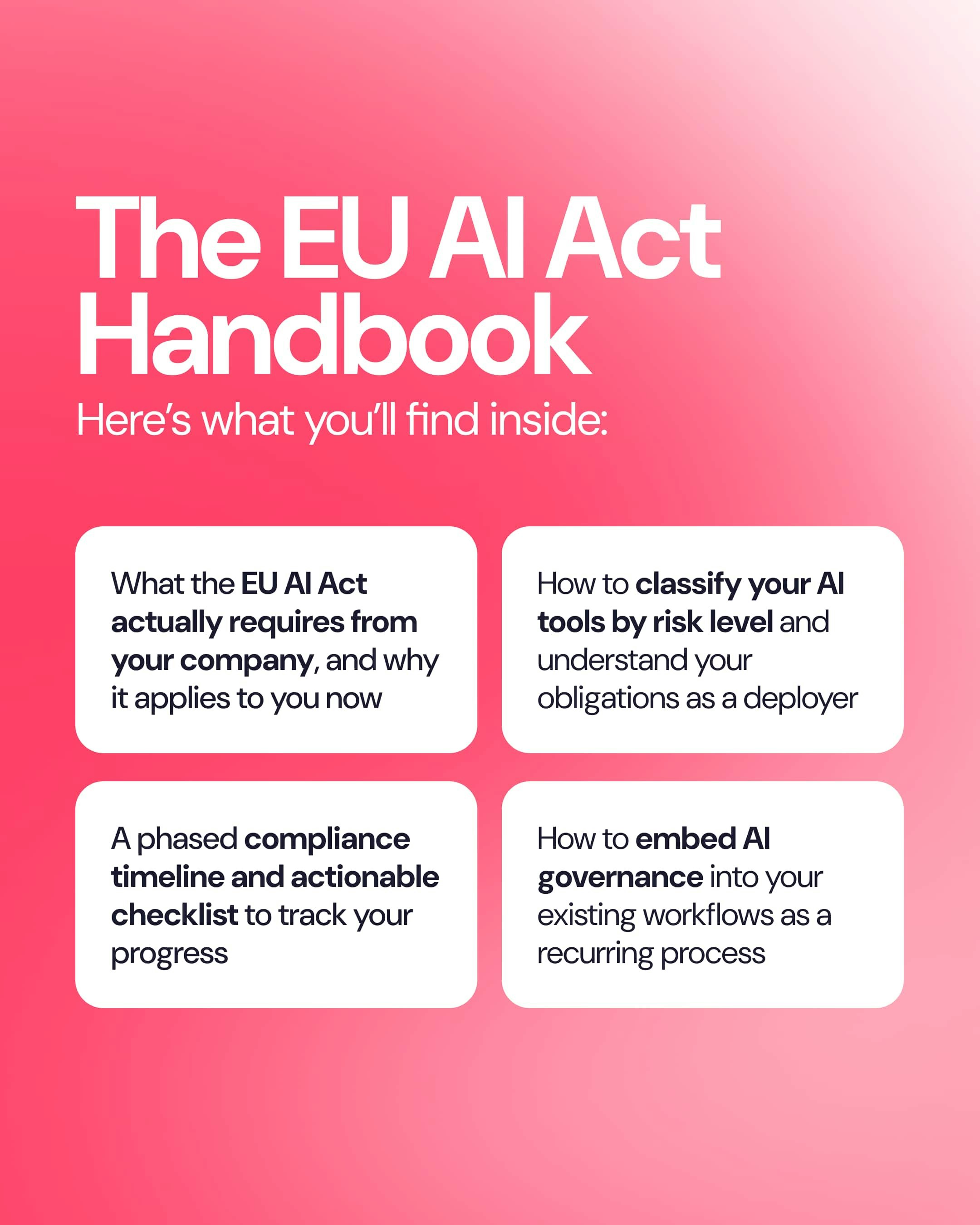
This handbook gives you a clear framework to understand what the law demands from your organization, identify which AI tools fall under its scope, classify them by risk level, and build the governance infrastructure to stay compliant as regulation continues to evolve.
Written for business leaders who need to act now without getting lost in legal complexity.
You need to build AI compliance into your business. Here's why:
€35M
is the maximum fine for deploying prohibited AI practices.
Feb 2025
The date Article 4 of AI Literacy became enforceable for all companies.
Aug 2026
National market surveillance authorities go operational across the EU.
What you will find inside this guide
The EU AI Act assigns specific obligations to every company that uses AI tools, regardless of size or industry.
This guide translates those obligations into a practical framework you can act on today: It covers what the law demands, the distinction between providers and deployers, how AI tools are classified by risk, and how Article 4's AI literacy obligation works in practice.
It includes a phased compliance timeline, a concrete checklist with named owners across Legal, HR, Finance, and IT, and a framework for embedding AI governance into your workflows permanently. Compliance under the EU AI Act is not a project with an end date.
Three phases, seven dates of the EU AI Act
The EU AI Act does not come into effect on a single day. It follows a structured rollout spread across four years. But that does not mean the clock has not started. It has.
Phase one is already done. The law became binding in August 2024. In February 2025, the first hard rules kicked in: a set of AI applications were banned outright, things like tools that manipulate people without their awareness or systems that score citizens based on their behavior. That same month, Article 4 became enforceable. Article 4 requires every organization using AI tools to ensure the people working with those tools understand them well enough to use them responsibly. If your company uses an AI chatbot, an automated scheduling tool, or any AI-assisted process, and you have no documented proof that your staff understands what those tools do, you are already out of compliance.
Phase two starts in August 2026. This is when enforcement becomes real: national authorities across every EU member state gain the power to investigate companies and issue fines. Before this date, the framework existed but the enforcement infrastructure was still being built. After August 2026, it is fully active.
Phase three covers the strictest obligations, those that apply to AI systems used in hiring, performance evaluation, or any decision that significantly affects people's employment. The deadline for these is December 2027, extended to August 2028 for AI embedded in regulated products.
The timeline is structured to be manageable, but only if you start now.
Frequently Asked Questions about the EU AI Act.
Straight to the point answers to the most frequently asked questions around team collaboration.