When hundreds or even thousands of applications land for a single role, finding the right candidates can quickly become overwhelming for HR teams. AI recruiting is changing the way companies approach this challenge, helping recruiters screen applications faster, identify qualified candidates, and reduce time spent on repetitive tasks.
According to SHRM’s 2026 State of AI in HR report, recruiting is the leading HR function for AI adoption, with 87% of organizations using AI in HR reporting efficiency improvements. From AI-powered resume screening to candidate matching, these tools can free recruiters from hours of manual work—giving them more time to focus on what matters most: making better hiring decisions.
Table of Contents
- Key Facts: AI Recruiting Tools
- What Are the Biggest Recruitment Challenges in 2026?
- How Does AI Work in Recruitment and Selection?
- Benefits of AI Recruiting
- Will AI Replace Recruiters? What the Data Shows
- Why Is AI Important in Recruitment Today?
- How Factorial AI Can Help with Talent Acquisition
- Top 10 AI Recruiting Software
- How to Choose AI Recruitment Software
- Factorial’s Built-in AI
- FAQ
Key Facts: AI Recruiting Tools
- What they are: AI recruiting tools automate candidate sourcing, resume screening, interview scheduling, and candidate communication – reducing manual workload and improving hiring accuracy across the full recruitment lifecycle.
- Adoption rate: The SHRM 2026 State of AI in HR report found that recruiting is the most common HR use case for AI at 27% of organizations surveyed, and 87% of HR AI users report efficiency gains.
- Recruiter challenge: The SHRM 2026 Talent Trends Report found that 68% of HR professionals reported difficulty recruiting full-time employees, and 53% said recruiting became more difficult than one year earlier.
- Quantified benefit: LinkedIn’s 2025 Future of Recruiting report found that talent professionals experimenting with or integrating generative AI in hiring saved about 20% of their workweek on average.
What Are the Biggest Recruitment Challenges in 2026?
HR professionals across industries face a significant challenge when hiring at any level: application volume. The U.S. Bureau of Labor Statistics reported 7.4 million job openings and 5.3 million hires in June 2026, which shows how many active roles hiring teams must manage at once. The SHRM 2026 Talent Trends Report also found that 68% of HR professionals had difficulty recruiting full-time employees.
To handle this large volume, HR managers spend a lot of time organizing and screening resumes to find the right candidates for interviews. But there’s a way to make this job easier. By using artificial intelligence (AI), they can save time on manual tasks and focus on finding the best candidates for the job.
SHRM’s recruiting research hub reports that 61% of recruiting professionals face challenges due to a lack of qualified candidates, making high-volume screening a quality problem as much as a workload problem.
The Challenge of Managing High Volume Applications
Finding the right candidates is tough with so many applications to review. HR managers must go through and organize each resume, which is time-consuming and can lead to mistakes. AI can help make this process more efficient.
Finding the Right Professional in a Sea of Talent
Identifying candidates with the right skills, qualifications, and cultural fit for a specific role can be a daunting task. HR managers must sift through resumes to find those that match the organization’s requirements and values. This is another challenge that AI can help overcome.
Competition for Top Talent
In today’s competitive job market, attracting and securing high-quality candidates can be difficult. Organizations need to stand out and communicate their employer brand clearly. Read on to see how AI can help!
How Does AI Work in Recruitment and Selection?
AI hiring tools are now key in recruitment, changing the hiring process by automating various stages and increasing efficiency. These AI tools for recruiting, integrated into the AI hiring process, include advanced algorithms for candidate sourcing, resume screening, and assessments. This ultimately improves the overall recruitment process.
With AI in recruitment and selection, organizations can make data-driven decisions, improve candidate matching, and reach better hiring outcomes.
- Define role requirements and must-have skills.
- Parse resumes against consistent criteria.
- Rank candidates for recruiter review.
- Schedule interviews and send status updates.
- Keep a documented hiring trail for audit and compliance review.
Benefits of AI Recruiting
AI recruiting can do more than automate repetitive hiring tasks. By speeding up candidate screening, organizing applicant data, and supporting recruiters throughout the hiring process, AI tools can help teams work more efficiently while making faster, more informed decisions. Here are some of the key benefits of using AI in recruiting.
Automating Administrative Tasks with AI
AI technology helps HR managers with repetitive tasks. For example, AI systems can sort and rank resumes automatically based on set criteria. They use algorithms to interpret education, skills, and experience. This speeds up and improves the accuracy of the screening process, a process known as resume parsing.
Improved Candidate Matching
AI algorithms match job requirements to candidate qualifications to determine who fits best. This enables HR managers to concentrate on candidates most likely to succeed in the role.
Reduced Cost per Hire and Time Savings
LinkedIn’s 2025 Future of Recruiting report found that talent professionals experimenting with or integrating generative AI in hiring saved about 20% of their workweek on average. The SHRM 2026 State of AI in HR report also found that 87% of HR AI users reported efficiency improvements, and 75% reported improved work quality.
Will AI Replace Recruiters? What the Data Shows
No. While concerns about job displacement are understandable, the evidence points toward task automation rather than recruiter replacement. LinkedIn’s 2025 Future of Recruiting report found that 73% of talent acquisition professionals agreed AI will change how companies hire, while the SHRM 2026 State of AI in HR report found that most HR AI users report efficiency gains rather than full automation. Administrative work is increasingly automated, allowing recruiters to focus on advisory work, relationship building, and hiring strategy.
AI will not replace humans in hiring. Instead, it helps HR managers by providing useful information and simplifying their workload. With AI handling administrative tasks, HR managers can focus on building relationships with candidates, leading more meaningful interviews, and assessing cultural fit. This personal approach improves the candidate experience and helps companies attract top talent.
AI Bias and Legal Compliance: What Recruiters Must Know
AI recruiting tools carry legal and ethical responsibilities that every HR team must address. The U.S. Equal Employment Opportunity Commission (EEOC) states that Title VII applies when employers use automated systems to make or inform selection decisions, and its 2024–2028 Strategic Enforcement Plan identifies AI and machine learning in recruitment and hiring as an enforcement priority.
State-level requirements add further obligations. The New York City Department of Consumer and Worker Protection says Local Law 144 requires an AEDT bias audit within one year of use, public availability of audit information, and candidate or employee notices before covered use in New York City. The Illinois General Assembly’s Artificial Intelligence Video Interview Act requires employers using AI to analyze video interviews to notify applicants, explain how the AI works, and obtain consent before the interview.
The U.S. Department of Labor’s AI & Inclusive Hiring Framework also urges employers to reduce accessibility barriers and discrimination risks when using AI-enabled hiring technology, especially for disabled job seekers.
Best practices for compliance include conducting regular bias audits, maintaining human review at key decision points, and ensuring your AI vendor can explain how its ranking criteria work. Choosing a platform with transparent scoring and documented audit trails is not just good practice – it is increasingly a legal requirement.
Why Is AI Important in Recruitment Today?
AI plays a vital role in modern recruitment by automating high-volume, repetitive tasks that previously consumed recruiter time. It allows teams to quickly review large numbers of applications, match candidates to job requirements, and reduce cost per hire. According to the SHRM 2026 State of AI in HR report, recruiting is the leading HR function for AI adoption at 27%, ahead of HR technology at 21%, learning and development at 17%, and employee experience at 14%.
AI Recruiting Software
HR managers in white-collar firms can use AI to make hiring easier. By using AI tools and systems, managers save time, cut costs, and find the right candidates more efficiently. Making AI part of a recruitment strategy is both a competitive advantage and a necessity given the job market today. Let AI support HR managers in achieving efficiency and excellence in hiring.
For SMEs, Factorial’s AI-powered hiring software ✅ is most useful when resume parsing, candidate communication, hiring stages, and HR records need to sit in one workflow rather than separate tools.
For an in-depth guide, see our free AI in HR ebook. Click the banner below to download:
How Factorial AI Can Help with Talent Acquisition
Factorial AI has user-friendly features that can transform talent recruitment, helping you connect with candidates who fit your requirements. In this blog post, we explain how Factorial uses AI to address recruitment challenges and improve your talent acquisition process. Candidate sourcing is made more efficient and effective through advanced algorithms and automation.
Smart Candidate Matching
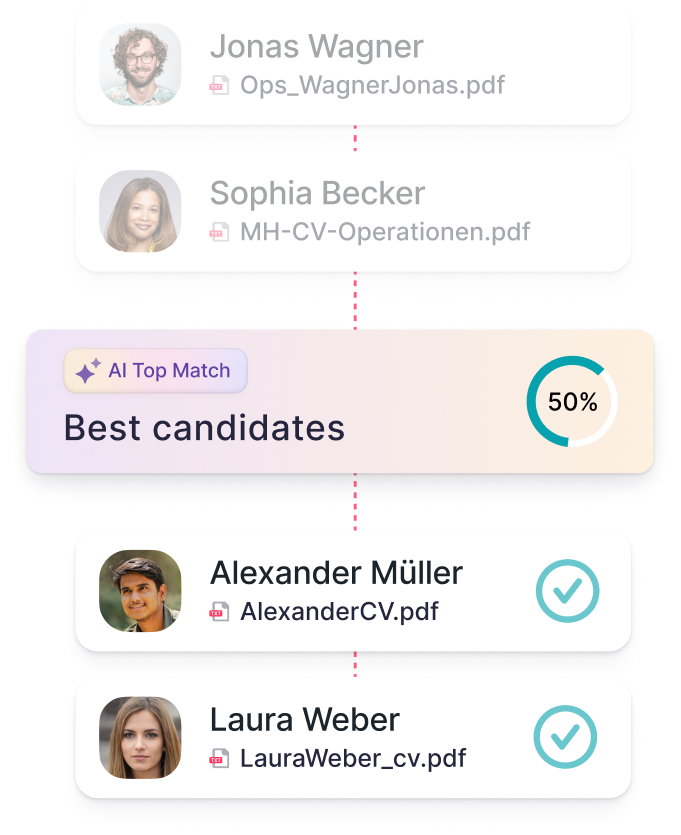
Factorial AI extracts relevant information from resumes and categorizes candidates by required skills and competencies. This saves time and ensures a set of suitable candidates.
Optimized Talent Pool
Factorial’s AI-powered talent pool optimization quickly identifies matches as soon as you post a job, speeding up the hiring process.
Easy Search System
Factorial’s search system makes it easier to find the best candidate from many applications. It interprets context and relevance in candidate profiles.
Custom Competency Descriptions
Factorial offers suggestions and automatic assignment of key competencies for each role and level. You can also add new competency descriptions to fit your organization’s needs.
Interested in how AI can help in the workplace? Watch our video below 👇
Top 10 AI Recruiting Software
Below are ten AI recruiting platforms worth evaluating. Note that AI tools vary significantly in scope – some cover the full hiring lifecycle, while others focus on specific tasks like sourcing or scheduling. Match the tool to your team’s actual workflow gaps before committing.
| Tool | Primary use case | AI capabilities | Team fit |
|---|---|---|---|
| Factorial | All-in-one HR and recruiting | Candidate matching, ATS, communication | SMEs and mid-market teams |
| HireVue | Video screening | Assessments and interview analysis | Enterprise hiring |
| Beamery | Talent CRM | Pipeline matching and outreach | Long-term sourcing |
| Ideal | Resume screening | Shortlisting and matching | High-volume review |
| Entelo | Sourcing | Candidate discovery | Diversity sourcing |
| Textio | Job-description writing | Language recommendations | Recruiting content |
| XOR.ai | Candidate chat | Chatbots and scheduling | High-volume communication |
| Avature | CRM and workflow | Outreach and reporting | Enterprise recruiting |
| Greenhouse | Structured hiring | Analytics and job-post support | Mid-market and enterprise teams |
| SmartRecruiters | Hiring management | Ranking, scheduling, collaboration | Large organizations |
1. Factorial
Factorial is an all-in-one HR and business management platform using AI to improve recruiting processes. It includes features such as candidate sourcing, applicant tracking, automated job posting, resume parsing, and candidate communication, making hiring more efficient and effective.
Best for: SMEs and mid-market organizations seeking an all-in-one HR and recruiting platform. Factorial is the editor’s choice for teams that want AI-powered candidate matching, applicant tracking, and HR management in a single system – without stitching together multiple point solutions.
2. HireVue
HireVue uses AI to help companies screen and interview job candidates. Recruiters can use video interviews, voice and facial analysis, and job-related assessments to learn more about each applicant. This can help hiring teams review candidates faster and focus their time on the people who best fit the role.
Use case: Enterprise teams that conduct high-volume video screening and structured assessments.
3. Beamery
Beamery is a talent relationship platform that uses AI to help recruiters find, organize, and stay in touch with candidates. It supports candidate sourcing, talent pipelines, and personalized messages. This helps companies build relationships with potential hires before they are ready to apply for a job.
Use case: Organizations focused on long-term talent relationship management and proactive pipeline building.
4. Ideal
Ideal uses AI and machine learning to speed up candidate screening. It reviews resumes, compares applicants with job requirements, and highlights people who may be a good match. Recruiters can then use these results to create a shorter list of qualified candidates to review.
Use case: Teams handling high application volumes that need AI-assisted shortlisting without replacing their existing ATS.
Improve your recruitment with Factorial AI
- Filter through candidate CVs with AI
- Centralize candidate communication
- Customize your recruitment funnel
5. Entelo
Entelo uses AI to help recruiters find candidates, including people from a wide range of backgrounds. It searches information from sources such as professional networks and social media, then helps recruiters identify potential matches. Its tools can also support diversity hiring efforts by helping teams reach a broader group of candidates.
Use case: Recruiting teams with active diversity hiring goals that need AI-assisted sourcing across professional networks.
6. Textio
Textio uses AI to improve job descriptions and recruiting messages. As recruiters write, the platform gives real-time suggestions about wording, tone, and inclusive language. This can help companies create job posts that are clearer and more welcoming to a wider range of applicants.
Use case: Recruiting teams that want to improve job description quality and reach a broader applicant pool.
7. XOR.ai
XOR.ai is an AI recruiting platform that uses chatbots to communicate with candidates. It can ask screening questions, schedule interviews, send updates, and answer common candidate questions. By handling these routine tasks automatically, it can help recruiters save time and give candidates faster responses.
Use case: High-volume hiring teams that need 24/7 candidate communication and automated screening question workflows.
8. Avature
Avature combines AI with candidate relationship management tools. Recruiters can use it to find candidates, track interactions, send personalized messages, and manage hiring steps in one place. It also offers reporting and automation features that can help larger teams keep their recruiting process organized.
Use case: Large enterprise teams that need a configurable candidate relationship management system with AI-assisted outreach.
9. Greenhouse
Greenhouse uses AI and hiring data to support recruiting teams throughout the hiring process. Its tools can help improve job posts, screen candidates, schedule interviews, and track hiring results. This gives teams a clearer view of their process and helps them make more informed hiring decisions.
Use case: Mid-market and enterprise teams that want structured hiring data, AI-assisted job posts, and detailed hiring analytics.
10. SmartRecruiters
SmartRecruiters is a hiring platform that uses AI automation for common recruiting tasks. It can help review resumes, rank candidates based on job needs, schedule interviews, and support teamwork between recruiters and hiring managers. The platform is designed to help companies manage hiring at a larger scale while keeping the process organized.
Use case: Large organizations managing high-volume hiring across multiple departments that need AI automation and recruiter collaboration tools.
ATS vs. AI Recruiting Software: What Is the Difference?
An applicant tracking system (ATS) is your system of record. It manages job postings, application intake, and hiring workflow. AI recruiting software is a layer that accelerates screening, surfaces ranked candidates, and automates communication. Many platforms, including Factorial, combine both functions in a single system, eliminating the need to manage separate tools. When evaluating any platform, confirm whether it replaces your ATS, integrates with it, or operates independently.
For resume screening, prioritize tools that show why a candidate was ranked, let recruiters adjust criteria, and preserve human review. The U.S. Equal Employment Opportunity Commission emphasizes that automated selection systems remain subject to federal employment-discrimination law.
To understand how AI is changing the workplace fundamentally, read more of our articles and ebooks on Applying AI to HR.
How to Choose AI Recruitment Software
- Purpose: Know why you want to use AI software and the goals you hope to meet.
- Compatibility: Check whether the AI software works well with your current systems and tools.
- Features: Examine features and pick the ones most important for your needs.
- Ease of Use: Make sure the software is user-friendly and doesn’t need advanced technical skills.
- Accuracy and auditability: Confirm the AI software is accurate, reliable, explainable, and testable for adverse impact. The U.S. Equal Employment Opportunity Commission notes that Title VII applies to automated systems used to make or inform selection decisions.
- Scalability: Ensure the tool can grow or adapt as your needs change.
- Data Privacy: Make sure your data stays safe, and the vendor complies with privacy laws.
- Vendor Reputation: Research the vendor to see if they have a good reputation.
- Cost and ROI: Weigh the software’s price against the value it provides.
- Future Updates: Check if the vendor regularly improves and updates the software.
- Human oversight: Decide which steps AI may support and which steps require recruiter or hiring-manager approval before a candidate is rejected, advanced, or offered a role.
What Questions Should You Ask an AI Recruiting Vendor?
- Bias audit documentation: Can the vendor provide results from independent bias audits? In New York City, the Department of Consumer and Worker Protection requires covered AEDTs to have a bias audit within one year of use, with audit information made publicly available.
- Explainability: Can the system explain why a candidate was ranked or rejected? If not, it presents a compliance risk in jurisdictions with AI transparency requirements.
- Integration depth: Does the tool connect natively with your existing ATS, HRIS, and calendar systems, or does it require manual data transfer?
- Candidate disclosure: Does the platform support candidate notices required by New York City’s AEDT rules and the Illinois General Assembly’s AI Video Interview Act consent requirement for AI-analyzed video interviews?
- Data privacy: Where is candidate data stored, and does the vendor comply with applicable state and federal privacy laws?
Factorial's Built-in AI
The integration of AI in the recruitment process has transformed the experience for employers and job seekers. By using AI, companies can ensure a better recruiting experience for both groups. HR managers avoid manual admin work and focus on higher-value tasks. Employer branding and creating an attractive workplace are very important, so make time for them. Positive company culture always matters.
Factorial’s AI-powered talent recruitment features help simplify the recruitment process for HR managers facing a high volume of applications. With AI, Factorial helps organizations focus on engaging with promising candidates. Through features like smart candidate matching, optimized talent pools, easy search, and customizable competency descriptions, Factorial helps HR managers overcome challenges in talent acquisition. Use AI to achieve successful recruitment outcomes with Factorial. Book a free demo to see how it works today.
A practical buying rule: choose AI recruiting software only after mapping the task it will improve, the human review point, the data it will process, and the audit trail your HR team needs to keep.
FAQ
What are the best AI recruiting tools for recruiters?
The best AI tools for recruiters automate repetitive tasks like sourcing and screening, allowing more time for strategic work. All-in-one business management software like Factorial integrates these AI features directly into the hiring process, simplifying everything from applicant tracking to creating competency descriptions for roles.
Which AI tool is best for resume screening?
The best AI tools for resume screening automatically parse, sort, and rank candidates based on skills and qualifications. Factorial, an all-in-one business management software, uses smart candidate matching to extract relevant information from resumes, helping recruiters quickly identify the most suitable applicants in a large talent pool.
What are the top 5 ATS systems?
Top ATS systems use AI to automate job posting, parse resumes, track applicants through custom hiring stages, and centralize communication. All-in-one business management software like Factorial includes a powerful AI-driven ATS to simplify the entire recruitment process, from sourcing candidates to making data-driven hiring decisions.