Transcription
Question 3: Why doesn't money alone keep anyone around anymore?
A) The salary isn't enough.B) The rules have changed.
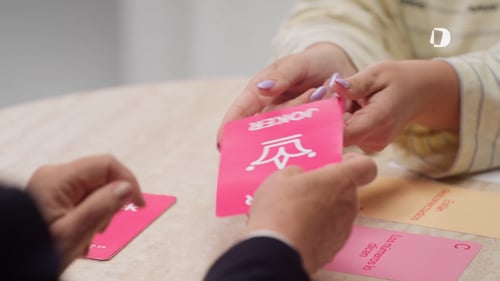
C) Without a bond, there is no loyalty.D) The joker.
I choose the joker because all the options listed are real and explain I'm not quite sure what's going on. So, the Joker.
Well, in this case, I'm torn between A and C, especially.
So I think I'll stick with option C—without a connection,there's no loyalty.
To me, all three make sense.I was torn between A and C, but I decided to go with C because I get the feeling that the letter A already covers a lot of things,since my salary isn't enough.
And these days, since there are so many more things that are gaining much more relevance, such as what we have already discussed regarding growth and progress,the benefits, the flexibility, as well as many other factors that come into play within the very notion that a salary isn't enough.
And then I thought that the C stood for the fact that without a bond, there is no loyalty,It has made me think a lot about corporate culture.
And I think it's a very important issue, and in fact,When I started at Factorial, I began working in the culture department.
And that's actually one of the things I like best.
I love development too, but, at its core, it's one of the things which makes me really excited because I think it’s very, very important that your purpose in life is closely linked to the company's mission itself,as if there were some consistency between the project I have The company and your purpose.
I think it's very important to fit in and feel like you're part of something,aside from, of course, the fact that you feel that what you do Okay, so you're the one making things happen; you're part of the machine.
I think there are many aspects there that are very important.
I completely agree.The truth is, everything matters here—as you've already seen, I've I've had a fling with the Joker.
But let's start with the basics.As you can see, I like to go for things that are very basic.
Maslow's hierarchy of needs, and he told us: needs come first To survive, I need money to buy food.
And it's true that I need a paycheck to be able to Or maybe not, but anyway,Let's just say I need an income.
I need an income to be able to eat, as Cervantes said,You can't write sonnets on an empty stomach.
So, there's a sort of order to it.But right now, it is very important to take a macro-social perspective.
Since the pandemic began, it has been a turning point for people he realized that life can slip away in a minute and having to put up with a job at If it doesn't satisfy you, you've got it to be done in as little time as possible.
Absolutely, this probably isn't the place for you.
There will definitely be a place for you.So, the rules have changed.
These days, people's relationship with work is different.
A lot of people say, "The thing is, Gen Z is" "the one that has changed the rules." No, look, no.
The rules have been changing for many years.Man, when the millennials came along, I remember that—hearing the Human resources directors: "Pfft!" "These people, there's just no way to" Of course, every generation has already brought a social evolution, a change; there has been an improvement,Until now, there had been social progress.
And that meant you had seen your parents work in a certain way In that way, you were always striving to live better and work better.
And this has led to the connection, the idea of: "What kind of relationship do I need to have "Has my situation at work changed?" These days, people work just enough to make a decent living,but he doesn't live to work.
And in the past, people lived to work, because they understood that their identity professionally, there are some who are still there,but your professional identity is what gives you value.
For the people it works for, well, it works for them—after all, we’re not all on the same level.
But keep in mind, professional identity has to do with what you do, where you do it, at what point you do it, and in what position you do it.
For many people, that professional identity is everything in their lives and when they retire or get laid off, all of that comes crashing down.
So, you're asking me about my life's purpose, and the thing is, my life's purpose was to remain at that company and in that position.
Many people who don't retire.That's right, and a lot of people can't stand the fact that they've left their jobs,who can't stand it because: "Who am I now?" "And who am I now?" So, take a look—there are some really interesting companies out there,I'm working on a very interesting project with people over 50 years, because, of course, they start to lose that connection.
And why do they start to lose that connection?Because they say, "What's the point at this stage?" So, how can we rekindle that connection? How can we foster that sense of legacy?
How can we promote the value of aging?Well, these are steps that some companies are taking right now.
So, the connection isn't just about you staying with a company,It's when you're at the company—what are you offering the company?
What values do you bring to the company?Girls, thank you so much for sharing your experiences,It has been incredibly rewarding.
The debate is over. Thank you very much.Well, thanks to you, thanks to Factorial.
We've run into each other before, but we haven't had the chance of spinning Of making a one.
To present our ideas in this way.Put our ideas into practice.
So whenever you're ready, we can meet up again.Wonderful. We've got that all sorted out.
Absolutely. Let's do it.