Skip to content

Transcription

00:07

Hello, I'm Joan Balaña, Sales Director at Factorial from the Partners ecosystem, and I’m here to talk about intelligence artificial intelligence applied to human resources.

00:16

My name is Pau Garcia-Milà. I am the CEO and co-founder of Founderz,and I have three children.

00:21

And I'm more concerned about the human resources for the next generation than for myself.

00:31

Hi, Pau and Joan!On the Deck works like this: first, you’ll answer a question without to find out what your partner will say, and then you'll have the chance to exchange ideas and explore your answers in greater depth.

00:43

Let's get started!Question 3: How do you really know what's going on in your How can AI help your business?

00:49

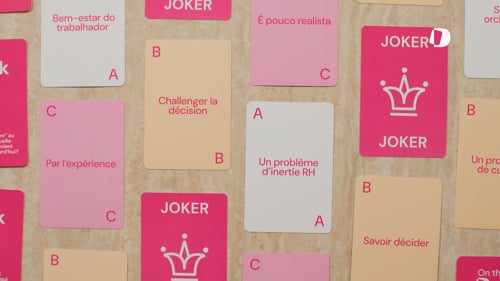
A) You listen to your team.B) You look at it from the outside.

00:53

C) Predict who will leave.Or D, the wild card. You get to guess who's leaving.

00:58

C.B, you're looking in from the outside.I was missing a D, which stood for "you don't know." I mean, but you think you know, right?

01:08

Yes, the biggest problem with AI is precisely how quickly it changes.

01:12

So, with a team of five people, you might find yourselves asking every day: Hey,Did you guys see what came out yesterday?

01:20

I'm already using this. Not me—what for?When there are 100 of you, it's already difficult.

01:28

With 1,700 users, there are people on Factorial who are already using features that were released yesterday,that their boss doesn't know they've left.

01:35

But of course, it's awful.What's the right answer here?

01:39

Sure, that would be at the company level or at a later stage,within the company, as subdivisions or something like that distinction in order to have Yes.

01:50

With more control, in a way, or more And control is really what you want, because there is a legal recourse and an efficient response.

01:59

How do you know what's going on in your company thanks to AI?

02:02

Sure, let's see—you listen to your team, observe from the outside, and learn who If you're leaving, I'll buy everything from you.

02:08

But legally, the only way to really see what's going on Thanks to AI, it would be like listening in or watching from the outside.

02:19

In other words, what I voted for, what it is, given what's happening based on anonymized data.

02:27

The moment you start trying to predict who will date AI,It means you're looking at things you shouldn't be looking at.

02:39

From a legal standpoint, the European Union’s new AI Act,It's as if every time it's about to take effect, a moratorium suddenly pops up and another year has gone by, but it’s still there, just waiting to resurface.

02:50

He makes that very clear.Sentiment analysis: illegal, pattern analysis So, in the end, it comes down to predicting who's leaving.

02:56

Sure, what would those predictive metrics be?Sure, it's dangerous. Internal communication channels or something like that?

03:03

Sure, it's dangerous.Well, if someone says to you, “All I did was look…” the conversations that person had with the AI, and I saw that they were "looking for another job." And you say, "Oh." Okay.

03:16

It's illegal. And you say, "Oh, I didn't know that." And if we consider how this might affect the way press releases are issued internally, or perhaps engage a little with the various dynamics at play,Legally speaking, where would that leave us?

03:32

Is it gray? Is it clearly?To be honest, I'm going to sound even more like an AI now, but my gut feeling and based on what I know regarding the upcoming regulations, anything that involves predicting Behaviors is an area we don't want to get into, and where I believe to the people in the company or on the teams They'd like to hear that we're not going in.

03:53

And really, do you think it takes much to predict that?

03:56

In other words, do we have to get to the point where we're dependent?

03:59

If it's 5, maybe not. If it's 500, how did you know?

04:03

But of course, this brings me back to what we were talking about earlier regarding middle managers.

04:06

To me, his role is precisely to listen and the ability to predict that, but with those one-on-one sessions,the follow-up you have with the team.

04:14

In my opinion, AI doesn't really need to be involved that much there.

04:17

And that prediction comes more from listening to or truly understanding who who you have or who you work with.

04:24

Pau and Joan, thank you so much for sharing your experiences—they really help us to better understand the changes that AI is bringing to human resources.

04:31

The debate is over.It's a pleasure, it's a pleasure.

04:34

I always learn something from you.