ISO 27001 and ISO 9001 are two of the most widely adopted international standards. They share the same structure and the same continual improvement philosophy, but they pursue different goals. ISO 27001 protects your organization’s information, while ISO 9001 organizes your processes to guarantee quality. That common foundation is exactly what makes them easy to confuse, or what leaves you unsure which one to roll out first.
In this article, you’ll see what each standard governs, how they differ, what they have in common, and how to decide which one your company needs or whether it makes sense to combine them.
What is ISO 27001?
ISO/IEC 27001 is the international standard that defines how to implement an information security management system (ISMS). Its goal is to protect three properties of information, namely confidentiality, integrity, and availability.
Rather than imposing a fixed list of measures, the standard requires you to analyze each organization’s risks and apply the appropriate controls to mitigate them. The current version, ISO/IEC 27001:2022, includes an Annex A with 93 controls grouped into four domains, namely organizational, people, physical, and technological.
Any company that handles sensitive data can become certified, though the standard is especially relevant in the technology, financial, healthcare, and legal sectors. Certification is voluntary, it is issued by an accredited body, and it remains valid for three years, with annual surveillance audits.
What is ISO 9001?
ISO 9001 is the international standard that governs quality management systems (QMS). Its purpose is to ensure that an organization’s products and services consistently meet customer requirements and applicable regulations.
It rests on principles such as customer focus, leadership, process-based management, and continual improvement. The current version is ISO 9001:2015, and it applies to organizations of any size and sector, from a small business looking to organize its operations to a large manufacturer seeking to certify its production line.
Unlike ISO 27001, it doesn’t focus on protecting information, but on operational efficiency and customer satisfaction.
Key differences between ISO 27001 and ISO 9001
Although they share the same structure, ISO 27001 and ISO 9001 pursue different goals and are applied differently. This table sums up the key points.
| Aspect | ISO 27001 | ISO 9001 |
|---|---|---|
| Goal | Information security | Quality of products and services |
| Management system | ISMS | QMS |
| Current version | ISO/IEC 27001:2022 | ISO 9001:2015 |
| Risk approach | Threats to confidentiality, integrity, and availability | Risks to product conformity and customer satisfaction |
| Controls | Annex A with 93 controls | No annex of controls |
| Key documentation | Security policy, risk assessment, statement of applicability, and incident management | Processes, quality metrics, and control of nonconformities |
| Primary beneficiary | Customer and data owner | End customer |
| Area involved | IT and security | Operations and quality |
The fundamental difference comes down to a single idea. ISO 9001 aims to make sure you do your work well on a consistent basis, while ISO 27001 protects the information that underpins that work. That’s why one is run out of operations and quality, and the other directly involves IT and security.
That difference in nature explains everything else. Because it centers on protecting data against real threats, ISO 27001 calls for a deeper risk assessment and more technical documentation, which usually translates into a more demanding rollout in terms of time and resources.
What do ISO 27001 and ISO 9001 have in common?
Despite their differences, both standards share more than it seems, because they follow the same ISO framework.
Both adopt the High-Level Structure (Annex SL), a common framework for ISO management system standards. As a result, the clauses on context, leadership, planning, support, evaluation, and improvement are practically identical across the two, which makes implementing them together far easier.
They also share the PDCA continual improvement cycle (plan, do, check, act), which structures how processes are managed, measured, and improved.
Other points in common include the following.
- Management commitment: both require leadership and active involvement from top management.
- Risk-based approach: both start by identifying and treating risks, even if those risks are different in nature.
- Audits and certification: both are certified through an accredited body and require periodic internal and external audits.
- Continual improvement: both require you to review and improve the system on an ongoing basis.
Which standard does your company need?
The choice depends on your sector, on what your customers ask of you, and on where your greatest risk lies.
ISO 9001 is the better fit if your priority is to organize processes, demonstrate operational consistency, and increase customer satisfaction. It’s a common requirement in public-sector and government contracts and in industries such as manufacturing, construction, and automotive.
ISO 27001 is the option if your business is built on processing, storing, or transmitting sensitive information, or if you compete for contracts that require evidence of security. It’s nearly essential for technology companies, SaaS providers, fintechs, and IT services, and it connects naturally with other security frameworks that matter in the US market, such as SOC 2, HIPAA, or CCPA.
If your company needs to cover both dimensions, quality and security, you don’t have to choose. Many organizations implement both standards at the same time to strengthen their operations and their data protection alike.
How to integrate ISO 27001 and ISO 9001
Because the two standards share the High-Level Structure, integrating them is more efficient than managing them separately. The shared clauses let you work with a single overarching policy, one internal audit team, and the same review schedule.
The main advantages of an integrated management system include the following.
- Fewer duplications: a single base of documentation and shared processes reduce the administrative burden.
- Unified risk management: a single risk matrix covers quality and security at the same time.
- Integrated audit: the same body assesses both systems in a single visit, which lowers costs and timelines.
- Shared culture: teams work toward aligned objectives and metrics across quality and security.
The key to integrating them well is to map your critical processes first, identify where quality and security requirements converge, and move forward in phases instead of trying to unify everything at once.
How Factorial IT helps you comply with ISO 27001
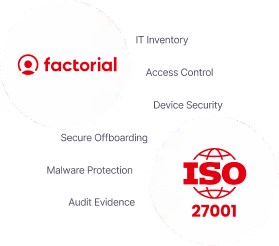
A good share of the technical controls in Annex A of ISO 27001 has to do with how you protect your organization’s devices, access, and data. Factorial IT brings together the tools to cover those controls on a single platform, without scattering management across several solutions.
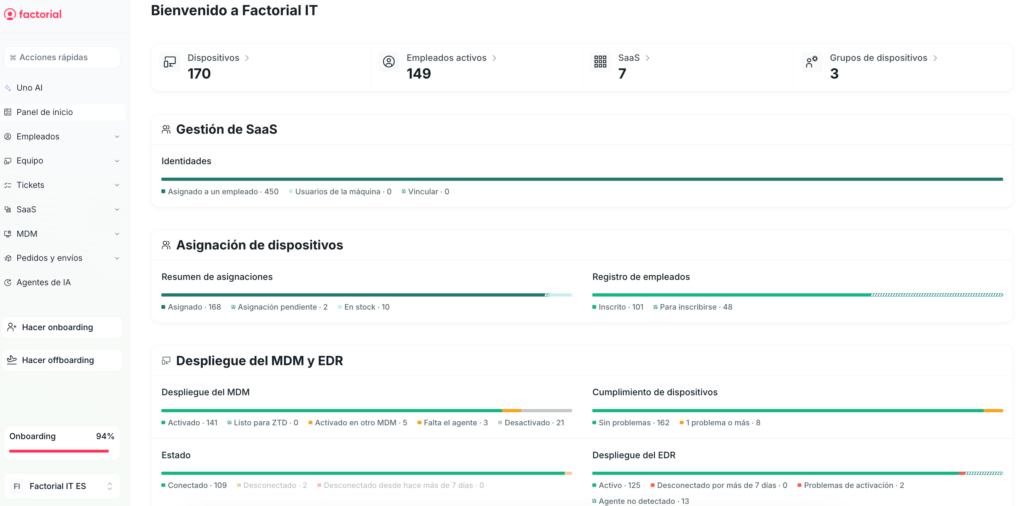
Here are some of the capabilities that help you move toward compliance.
- Device management (MDM): applies security and encryption policies across your entire fleet of Mac, Windows, and Linux devices.
- Automatic IT inventory: keeps an up-to-date catalog of every device and application, the foundation of asset management within the ISMS.
- SaaS access management: centralizes who can access each tool, with automatic provisioning and deprovisioning based on the employee’s profile.
- Integrated EDR: detects and responds to threats on every endpoint to strengthen protection against incidents.
- Automatic offboarding: revokes access immediately when someone leaves the company, with no manual steps.
- Audit evidence: generates tamper-proof logs and compliance reports you can export at any time.