These days, information is one of the most valuable assets a company has, and one of the most exposed. Most organizations protect their data with a patchwork of standalone measures like antivirus software, backups, and passwords of varying strength.
The trouble starts when none of those measures follow a shared plan. Nobody knows for sure what’s actually protected, who owns what, or what to do when something goes wrong. An information security management system exists to fix exactly that. It brings order to the chaos and turns a scattered set of measures into an organized, verifiable way to protect information.
In this article, we’ll walk through what an ISMS is, what it’s for, what it’s made of, and how it works through the cycle of continuous improvement. We’ll also look at who owns it inside the company and how it lines up with the compliance frameworks that matter in the US, from ISO 27001 to SOC 2.
What is an information security management system (ISMS)?
An information security management system, or ISMS, is the full set of policies, processes, people, and technology a company puts in place to protect its information in a systematic way. The goal is for security to stop depending on one person’s occasional effort and become part of how the organization runs day to day.
It all comes down to the word system. Antivirus software, a few backups, or strong passwords are good practices, but on their own they’re just isolated pieces. What turns them into an ISMS is the method that organizes them and ties them together. That method always follows the same logic. First it identifies which information needs protecting, then it analyzes the risks that information faces, from there it decides which controls to apply, and finally it checks on a regular basis that everything still works.
Every ISMS is built around three properties that have to be preserved for any piece of data, known as the CIA triad.
- Confidentiality: only authorized people can access each piece of data.
- Integrity: information isn’t altered or deleted without permission.
- Availability: information is accessible when it’s needed.
The idea of an ISMS is closely tied to ISO 27001, the international standard that lays out the requirements for building and maintaining one. In fact, when a company gets ISO 27001 certified, what the certification body audits is precisely its ISMS. Even so, an ISMS and the standard aren’t the same thing. A company can run a working management system without being certified, and certification only means something when there’s a real ISMS behind it.
What is an ISMS for?
The main job of an ISMS is to manage risk in an orderly way. Instead of reacting to problems as they come up, the company gets ahead of them, weighs the impact each one would have, and decides in advance how to respond. It’s the shift from reactive security to managed security. Beyond that core function, putting an ISMS in place brings concrete benefits.
- It lowers the likelihood and impact of incidents: preventive controls slow attacks down, and response procedures shorten recovery time.
- It streamlines compliance: a single system helps you meet ISO 27001, SOC 2, HIPAA, and CCPA at once, since they share a good chunk of their requirements.
- It builds trust with customers and partners: it’s objective proof that the company protects the information it’s trusted with.
- It clarifies responsibilities: everyone knows what information they handle, how to protect it, and who to notify if there’s an incident.
- It makes decisions easier: by inventorying assets and assessing risk, leadership can direct security spending where it’s actually needed.
What components make up an ISMS?
An ISMS isn’t a product you buy or software you install. It’s a combination of pieces that work together. While every organization tailors its system to its size and industry, all ISMS share the same basic components.
1- The scope of the system
Scope defines how far the ISMS reaches, meaning which parts of the company the system covers. An organization can apply its ISMS to the whole company, to a single business unit, to a specific product, or to one location. Setting the scope well is one of the first decisions you make, and one of the most important.
2- Risk analysis and treatment
This means identifying the company’s information assets, studying the threats and vulnerabilities they’re exposed to, and calculating the level of risk by combining likelihood and impact. With that analysis in hand, the company decides how to treat each risk. It can reduce it by applying controls, transfer it by buying insurance, accept it if it stays within a tolerable threshold, or avoid it by dropping the activity that creates it.
3- Security policies and procedures
Policies are the rules that set how information gets protected across the company. The most important one is the general security policy, signed off by leadership, which the other more specific rules depend on, covering passwords, device use, access control, or vendor management. Procedures take those rules to the ground level and spell out step by step how each task gets done.
4- Security controls
Controls are the concrete measures a company applies to reduce its risks. They can be technical like encryption or two-factor authentication, organizational like classifying information, physical like access control at the office, or people-related like training.
5- Documentation and evidence
An ISMS needs documentation to function, and that documentation comes in two kinds. On one side, the documents that form the backbone of the system, like the scope, the security policy, the risk analysis, or the Statement of Applicability. On the other, the evidence that proves the system actually works, like access logs, audit reports, or incident records.
How does an ISMS work?
An ISMS isn’t something you set up once and forget. It runs as a cycle that repeats continuously so it can adapt to changes in the company and to new threats as they emerge. That cycle is known as PDCA, for Plan, Do, Check, Act. It’s the same continuous-improvement model other management standards use, like ISO 9001 for quality.
- Plan: the company defines the system’s scope, assesses its risks, and decides which controls to apply. This is the design phase, where the ISMS foundations get laid.
- Do: what was planned gets put into practice. Controls are turned on, policies are written, technical tools are configured, and staff are trained.
- Check: the company confirms the system is working the way it should through internal audits, metrics, and management review. This is where gaps and weak spots surface.
- Act: whatever isn’t working gets fixed, and improvements are rolled out. The findings feed into a new round of planning, and the cycle starts over.
Who's responsible for an ISMS in the company?
One of the most common misconceptions is thinking an ISMS is the IT department’s job alone. Information security touches the whole organization, and running it involves several roles with different responsibilities.
- Executive leadership: it holds ultimate responsibility for the ISMS. It approves the security policy, allocates budget and resources, and backs the project. Without its commitment the system falls apart, because no one below has the authority to require measures from other departments.
- The security lead or CISO: this is who coordinates the ISMS day to day. They drive the risk analysis, oversee how controls get implemented, and report to leadership. At smaller companies, this role might fall to the IT lead or be outsourced.
- The security committee: it brings together representatives from different areas like IT, legal, HR, or operations. Its job is to make cross-functional decisions and make sure security is baked into every process, not just the technical ones.
- Employees: they’re an active part of the system. Everyone who handles information is responsible for following the policies, protecting the data they can access, and flagging anything that looks off. Most breaches start with human error, which makes this role a decisive one.
ISMS and compliance in the US
An ISMS doesn’t exist in a vacuum. In the US, several frameworks require or recommend managing information security in a structured way, and one well-designed system lets you satisfy more than one at a time. Here are the main ones.
- ISO 27001: the international standard that sets the requirements for building an ISMS. It’s voluntary, but it’s become the de facto benchmark for showing a company manages its security well, and plenty of customers and RFPs ask for it before they’ll sign. You can see how certification works in our guide to ISO 27001.
- SOC 2: an attestation report based on the AICPA’s Trust Services Criteria, and the one US customers ask for most often, especially in SaaS and B2B. It leans on many of the same controls an ISMS already covers, so a company with an ISMS in place is most of the way there.
- HIPAA: if you handle protected health information, it sets specific safeguards for keeping that data secure and private. An ISMS gives you the risk management and controls that back those requirements up.
- CCPA and state privacy laws: they govern how personal data is collected and protected, and they lean on a lot of the measures an ISMS already handles. A structured system makes it much easier to show you’re meeting them.
How Factorial IT helps you manage your ISMS
Throughout this article we’ve seen that an ISMS rests on components like the asset inventory, the technical controls, and the evidence that proves everything’s working. Those three are exactly the hardest to keep current by hand, and where the most gaps show up when a review comes around.
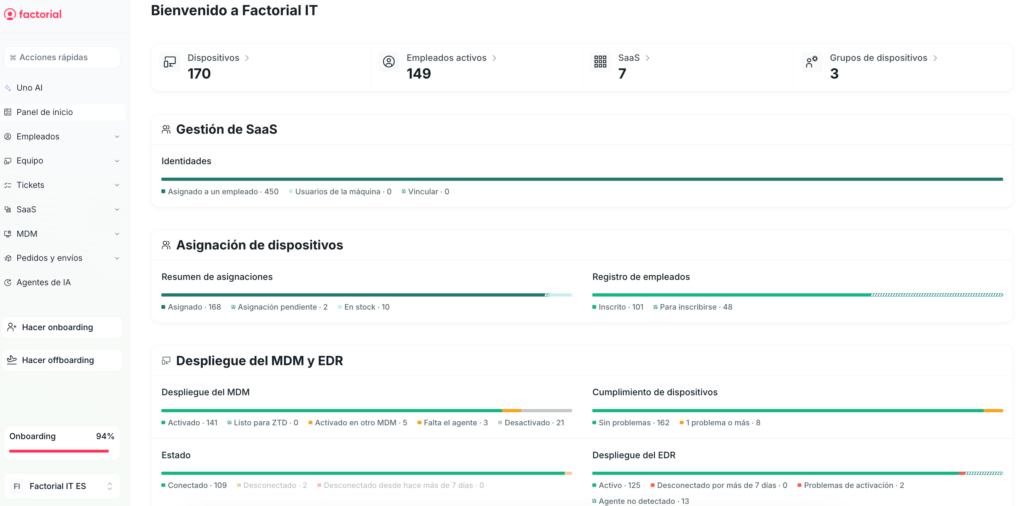
Factorial IT automates that operational layer and connects it to HR, so each component feeds itself from the company’s everyday activity.
- On the asset inventory: it keeps an up-to-date catalog of devices, software, and access, ready to export the moment the ISMS needs it.
- On technical controls: it enforces encryption, passwords, and lock screens on every device, and adjusts tool access to match each person’s role, including automatic shutoff when someone leaves.
- On evidence: it generates the logs and compliance reports an audit asks for, without having to rebuild them by hand on review day.