Outdated HR policies and inconsistent processes can create compliance gaps before leaders realize there’s a problem. A practical HR audit checklist helps U.S. employers regularly review employee records, payroll practices, benefits, workplace policies, employee relations, and key employment-law obligations.
But an effective HR audit is about more than checking boxes. It’s an opportunity to identify risks, update outdated practices, improve documentation, and make sure your HR processes support both your employees and your organization.
In this guide, we’ll walk you through the key areas to include in an HR audit, along with a free, ready-to-use HR audit checklist template for 2026. Use it to structure your review, identify areas that need attention, and turn your audit findings into actionable next steps.
Table of Contents
- Key Facts
- What Is an HR Audit?
- What Are the Main Types of HR Audits?
- Why Should You Conduct an HR Audit?
- Steps to Perform an HR Audit
- How to Use an HR Audit Checklist to Ensure Compliance
- Why Should You Use an HR Audit Template?
- What Should HR Teams Know Before an Audit?
Key Facts
- An HR audit checklist is a structured annual review of HR policies, records, payroll practices, employee relations, and compliance controls.
- The U.S. Equal Employment Opportunity Commission (EEOC) reported 88,201 new discrimination charges and $660 million recovered for 17,680 victims in fiscal year 2025, making employment-law documentation a measurable audit priority.
- The Occupational Safety and Health Administration (OSHA)’s 2026 penalty memo lists maximum penalties of $16,550 per serious, other-than-serious, or posting violation and $165,514 per willful or repeated violation.
- The Society for Human Resource Management (SHRM)’s HR audit guidance recommends annual checkups and notes that mini-audits can be completed approximately every six months.
What Is an HR Audit?
The definition of an HR audit is a thorough review of the policies, procedures, documents, and systems in Human Resources. HR professionals conducting an audit systematically review every facet of their work and contribution to the company.
This is an opportunity to identify which practices are working and which are not. This is a vital step when it comes to improving operations and performance. Usually, HR professionals will carry out the audit. However, companies can also choose to hire an external company to conduct a human resources evaluation.
Related: Watch this quick video that explains everything you need to know about HR audit checklists 👇
Considering the time and effort that you need to invest in a full-scale assessment, it is advisable to perform an audit once a year.
The completion of one HR audit checklist yearly should be enough for your company to obtain all the HR-related data it needs. When you make an assessment, you can choose to focus on the following areas:
- Recruitment
- Onboarding
- Management
- Training and Development
- Employee Relations
- Performance
- Strategic Planning
- Documentation
- Best Practices
- Compliance with Laws and Regulations
For U.S. employers, the checklist should also map each HR area to a legal or operational control.
| Audit area | What to verify | Why it matters |
|---|---|---|
| Wage and hour | Review exempt status, overtime rules, and payroll records. | The U.S. Department of Labor applies the 2019 EAP salary level of $684 per week and $107,432 per year for highly compensated employees after the 2024 rule was vacated. |
| I-9 records | Check completion, reverification, and retention. | The U.S. Citizenship and Immigration Services (USCIS) requires employers to keep Form I-9 for three years after hire or one year after termination, whichever is later. |
| Leave administration | Review FMLA eligibility, notices, and tracking. | The U.S. Department of Labor states that FMLA applies to private-sector employers with 50 or more employees and provides eligible employees up to 12 workweeks of leave. |
| EEO reporting | Confirm whether EEO-1 reporting applies. | The EEOC states that employers with at least 100 employees and qualifying federal contractors with at least 50 employees must submit EEO-1 data every year. |
| Required posters | Check federal, state, and local posting requirements. | The U.S. Department of Labor notes that poster requirements vary by statute and provides the elaws Poster Advisor for determining required workplace notices. |
This section supports users searching for an HR compliance audit or needing compliance checklists for U.S. requirements.
What Are the Main Types of HR Audits?
The Society for Human Resource Management (SHRM) identifies four common HR audit categories: compliance, best practices, strategic, and function-specific audits. Use the table below to choose the right format before building your checklist.
| Audit type | Best use case | What to review |
|---|---|---|
| Comparative approach audit | Compare practices across departments, locations, or business units. | Policies, cycle times, HR service levels, and process consistency. |
| Expert audit | Bring in external HR, legal, or compliance expertise when internal capacity is limited. | High-risk policies, employee files, payroll practices, and compliance controls. |
| Statistical approach audit | Use internal HR data to assess performance and risk. | Absenteeism, hiring speed, grievance trends, and turnover rates. |
| Management by objectives audit | Check whether HR met defined goals from the prior cycle. | Goal completion, KPI movement, and setting and reaching OKRs. |
Why Should You Conduct an HR Audit?
There are many advantages to conducting an HR audit. Without a doubt, the most valued is that it provides you with a broad vision of the inner workings of your company. The audit often reveals how the human resources department fulfills its daily functions.
An audit is a comprehensive tool used to analyze multiple aspects of a company. Conducting an audit is essential to a company’s growth and improvement.
Knowing the inner workings of your organization allows your company to detect potential complications and/or areas of improvement. Also, as a result of conducting an audit, you can see where the HR team is already doing a great job. Highlighting these wins can be great for morale.
Beyond just staying updated, regular audits serve as documented proof that your company is actively abiding by federal, state, and local labor rules. Should a legal dispute or inspection arise, having a clear audit trail demonstrates good faith and proactive management. Using a centralized system like Factorial automatically logs policy acknowledgments and document updates, so your ‘proof’ is always ready to pull.
Still on the fence? Here are the key advantages of performing an HR audit.
Key Benefits of an HR Audit
An HR audit can do more than identify compliance issues. A regular review gives employers a clearer picture of what’s working, where risks may exist, and which HR processes need attention. Here are some of the key benefits of conducting an HR audit.
Provides a detailed vision of the human resources department
Understanding how each area of the department works and how they integrate into the company is essential to moving forward with the company’s objectives.
Encourages compliance
It is in a company’s best interest to ensure compliance with ever-changing rules that affect hiring, payroll, leave, employee records, workplace safety, and terminations. For example, the U.S. Department of Labor currently applies the 2019 Fair Labor Standards Act (FLSA) EAP salary threshold of $684 per week after the 2024 overtime rule was vacated.
Promotes positive change
Evolving is crucial. Identifying a company’s weaknesses or possible pain points enables it to better form a plan of action and implement it to improve.
Provides valuable data
If you are a regular reader of the blog, you know that we love speaking about the collection of reliable data. Why? This data allows a company to quantify aspects of its HR department that may have previously been neglected. With an audit, you can retrieve valuable data that, after proper analysis, will help guide you to make the correct decisions later on.
A centralized HR platform can make the evidence-gathering stage easier. Factorial helps teams keep employee documents, time records, performance data, and policy acknowledgments in one place so audit findings are easier to verify and assign.

Steps to Perform an HR Audit
If you are thinking about conducting an audit of your company, you may be feeling a bit stressed. Are you wondering where to start, which steps to take, and who will be the one performing the audit?
Although there are many different ways to conduct an HR audit, most assessments move from scope-setting to remediation. SHRM’s model includes seven key steps: determine scope, develop the questionnaire, collect data, benchmark findings, provide feedback, create action plans, and support continuous improvement.
Pre-Audit
The first step is the pre-audit. During this phase, you will need to determine what data would be most useful to collect. Start by defining which HR functions or processes you would like to evaluate under the audit.
For example, you may want to review your HRIS, the policies of the HR department, or performance evaluations. If there is an area in your company that requires improvement, you should consider adding it to the audit as well.
Our advice is to let HR metrics drive these decisions. If you are keeping track of KPIs such as time-to-hire and retention rate, you’ll probably have a pretty good idea of where your HR department is falling short.
As soon as you have identified areas for improvement, you can continue to the next steps of the HR audit process:
- Decide whether the audit will be conducted internally, externally, or with outside legal counsel for higher-risk compliance reviews.
- Define the audit type you want to carry out.
- Establish clear and defined objectives to result from the audit.
- Create a plan of action to arrive at your objectives.
Analysis of the data
The next step is the analysis of the data. In this step, you will assess the processes, procedures, policies, documents, and data that you decided to audit in the previous step. Collect the information in an organized fashion so that you can draw conclusions.
Collecting this data manually across multiple spreadsheets can take weeks. By using an all-in-one HR software, you can instantly generate custom reports on turnover rates, absenteeism, and payroll. This allows your team to focus on analyzing the data and improving company culture, rather than getting bogged down in data gathering.
Prepare a report with your audit results
The final step is to draft a report that contains your findings and recommendations, which will aid the Human Resources team in succeeding.
For each finding, include a risk rating, owner, due date, evidence needed, and completion status. This turns the HR audit checklist from a diagnostic document into a remediation plan.
This section helps ensure your HR audit report is actionable beyond a static checklist.
How to Use an HR Audit Checklist to Ensure Compliance
An HR audit checklist provides a roadmap of your audit. Using a checklist for HR audit processes ensures you don’t miss anything—from updating I-9 records to tracking FMLA eligibility. It is your ultimate tool to ensure compliance, avoid costly penalties, and transition from reactive to proactive HR management.
It shows what essential functions you absolutely must review. Sometimes this is not as intuitive as you would expect. We may be so accustomed to our old, tired processes that it doesn’t occur to us that there’s a better way to do things.
An audit is a key moment for the department and the company as a whole, so they can learn and keep moving forward as an HR professional. Using a checklist for HR audit processes ensures you don’t miss anything. This is particularly relevant for anyone undertaking an employee records audit or similar process to verify documentation consistency.
Why Should You Use an HR Audit Template?
Whether the focus lies on policies or performance, a yearly review of your HR uncovers problems and challenges that exist within the department. Evaluating these issues allows your company to improve and prevents negligence or complacency.
Furthermore, using an HR audit checklist helps guarantee that your company is in accordance with current HR and employment laws. It provides managers with a clear vision of what’s happening in the company, enabling them to determine best practices and discover opportunities for growth and development.
An effective HR audit will also have a positive effect on employees. It increases transparency, which has been shown to boost employee morale, and shows that the company is committed to constant improvement. These positive changes lead to increased productivity and employee satisfaction.
Download Your Free HR Audit Checklist Template
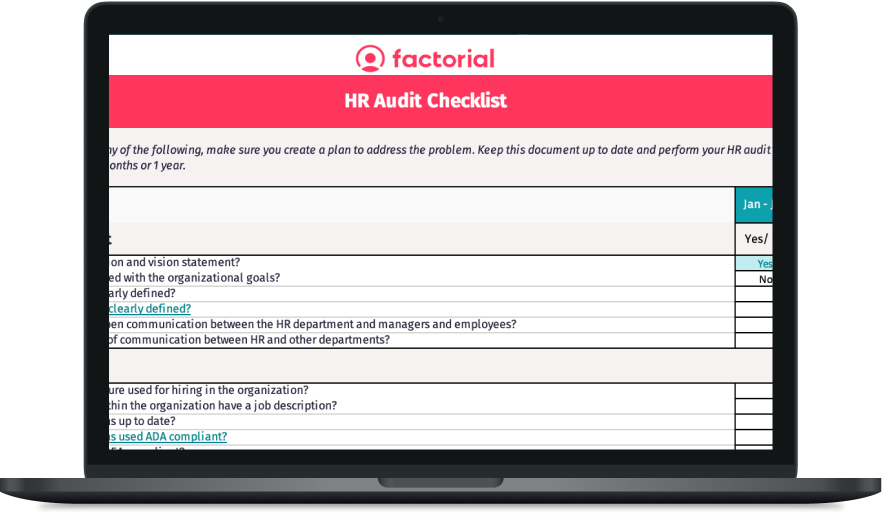
Before starting an HR audit, it helps to have a checklist that keeps the process organized and ensures you don’t overlook important areas. Our free HR audit checklist template provides a practical framework for reviewing key HR processes, policies, records, and compliance requirements.
Use the template to document your findings, track areas that need attention, and stay organized throughout the audit process. For 2026, consider adding columns for federal, state, and local requirements, as well as the relevant source document or policy owner, to make future updates easier to manage.
Need a little extra help managing your HR processes? Factorial offers an all-in-one platform for managing employee records, time tracking, payroll, and other HR tasks in one centralized system. Discover Factorial and see how it can support your HR team.
What Should HR Teams Know Before an Audit?
What Should HR Teams Know Before an Audit?
Preparing for an HR audit starts before you begin reviewing policies and employee records. HR teams should understand the scope of the audit, gather the right documentation, and identify any areas that may need closer attention.
A little preparation can make the audit process more efficient and help your team address potential compliance gaps before they become bigger issues. Here’s what HR teams should know before getting started.
How to prepare for an HR audit?
When it comes to HR audits, you should take a proactive approach rather than a reactive one. It’s best to prepare strategically and follow these key steps:
- Review HR policies and procedures: Make sure all company documents and processes are up to date. Including, employee handbooks, compliance documents, and more.
- Assess compliance: Ensure your company is following federal, state, and local labor laws, tax rules, required workplace notices, and internal policies. The U.S. Department of Labor notes that required workplace posters vary by statute, so posting requirements should be reviewed during each audit.
- Gather data: Review your core HR metrics such as turnover rates, absenteeism, and performance to gauge how effective your HR efforts are.
- Transparency: Inform your team about relevant details of the audit, timeline, their roles, and expectations.
What are the three levels of HR audit?
The three levels of HR audit are compliance, benchmarking, and strategic. They all assess a different aspect of HR to ensure HR teams are complying with employment laws and they are positively impacting the company.
Is HR audit mandatory?
A general HR audit is not usually a single federal legal requirement. However, the records and practices reviewed during an audit can be mandatory, including Form I-9 retention, EEO-1 reporting for covered employers, FMLA notices, and required workplace posters.
Who conducts an HR audit?
HR audits can be conducted both internally and externally. Factors like the type of audit, situation, and other aspects will determine if the audit will be conducted by an internal or external member.
FAQ
What does an HR audit include?
An HR audit is a comprehensive review of a company’s human resources policies, procedures, documents, and systems. It typically covers key areas like recruitment, onboarding, performance management, employee relations, documentation, and overall compliance with labor and employment laws to identify strengths and areas for improvement.
What are the 7 steps in the audit process?
The HR audit process involves defining the audit’s scope and objectives, creating an action plan, collecting and analyzing data, and preparing a final report. Key steps include deciding on an internal or external audit, choosing an audit type, and outlining clear recommendations for improvement based on the findings.
What should be included in an audit checklist?
An HR audit checklist should cover essential functions like recruitment, performance management, documentation, and legal compliance. Using an all-in-one business management software like Factorial can simplify this by centralizing employee documents and data, ensuring records are always up-to-date and accessible for the audit.