Employee engagement software helps you listen to your people, spot problems early, and build a workplace where employees want to stay and grow. In this guide, you’ll learn what it is, why it matters, and discover the 10 best tools on the market today, starting with Factorial.
What is employee engagement software
Employee engagement software is a digital tool that helps you understand how employees feel at work and take action to improve their experience. It usually includes features like surveys, feedback forms, recognition tools, and dashboards so HR and managers can track engagement over time.
According to Gallup’s survey, employee engagement fell to 20% in 2026, the lowest it has been since 2020. Lower engagement leads to a loss in productivity, making it a top priority for employers to investigate why employees feel less engaged.
Instead of relying on a once‑a‑year survey or gut feeling, engagement software gives you regular data about motivation and stress in the workplace. When you have these insights, you can support teams that are struggling, celebrate teams that are thriving, and make better decisions about people and culture.
Benefits of using software for employee engagement
Using employee engagement software brings clear benefits for HR, managers, and employees:
- Higher productivity: Engaged employees are more focused, more creative, and more willing to go the extra mile to help the company succeed.
- Lower turnover: When people feel heard, valued, and supported, they are less likely to leave for another job.
- Better communication: Regular surveys, pulse surveys, and feedback tools open two‑way conversations between staff and leaders.
- Stronger culture: Recognition, peer shout‑outs, and clear goals help you build a culture of trust and appreciation.
- Faster decisions: Dashboards and analytics show engagement trends in real time, so you can act quickly instead of waiting for annual reviews.
- Support for well‑being: Many tools include wellness questions and burnout indicators that help you protect mental health and work–life balance.
For growing companies, software also helps standardize engagement across different locations and work models, whether your teams are remote, hybrid, or onsite.
Employee engagement software comparison chart
Here is a quick overview of 10 popular employee engagement tools, their main strengths, and who they are best for.
| Software | Main features (short) | Best for | Price |
|---|---|---|---|
| Factorial | HRIS + time off, surveys, performance, shifts, analytics | Small and mid‑size companies that want HR + engagement | Factorial starts at $8 per month, per user |
| Lattice | Engagement surveys, performance reviews, goals, 1:1s, analytics | Growing and large companies needing all‑in‑one people platform | Starts at $11 PEPM + $4 for Engagement module |
| Culture Amp | Engagement surveys, DEI, performance, manager coaching | Companies focused on culture, feedback, and inclusion | Pricing available upon request |
| 15Five | Weekly check‑ins, engagement surveys, OKRs, manager coaching | Teams that want simple, continuous feedback and goals | $4 per user per month |
| BambooHR | Core HRIS, time off, payroll, performance, basic engagement | Small and mid‑size businesses wanting HR + engagement | $10 per employee per month |
| WorkTango | Engagement and pulse surveys, analytics, recognition and rewards | Organizations that want deep survey insights plus recognition | Pricing available upon request |
| Bonusly | Peer recognition, points and rewards, engagement reporting | Companies that want fun, lightweight recognition | Free for small teams, paid starts at $3 PEPM |
| Achievers | Recognition and rewards, engagement analytics, integrations | Mid‑size and large companies focused on recognition | Pricing available upon request |
| SurveyMonkey | Employee surveys, templates, analytics, integrations | Teams that mainly need flexible survey tools | Starts at €30 per user per month |
| Leapsome | Engagement surveys, OKRs, reviews, learning modules | Product‑driven companies tying engagement to growth | Pricing available upon request |
*Pricing is subject to change. Always check vendor pricing before making a decision.
Top 10 employee engagement software
Now that you have a broad overview of the employee engagement software options, we will take a deeper look at each solution.
1. Factorial
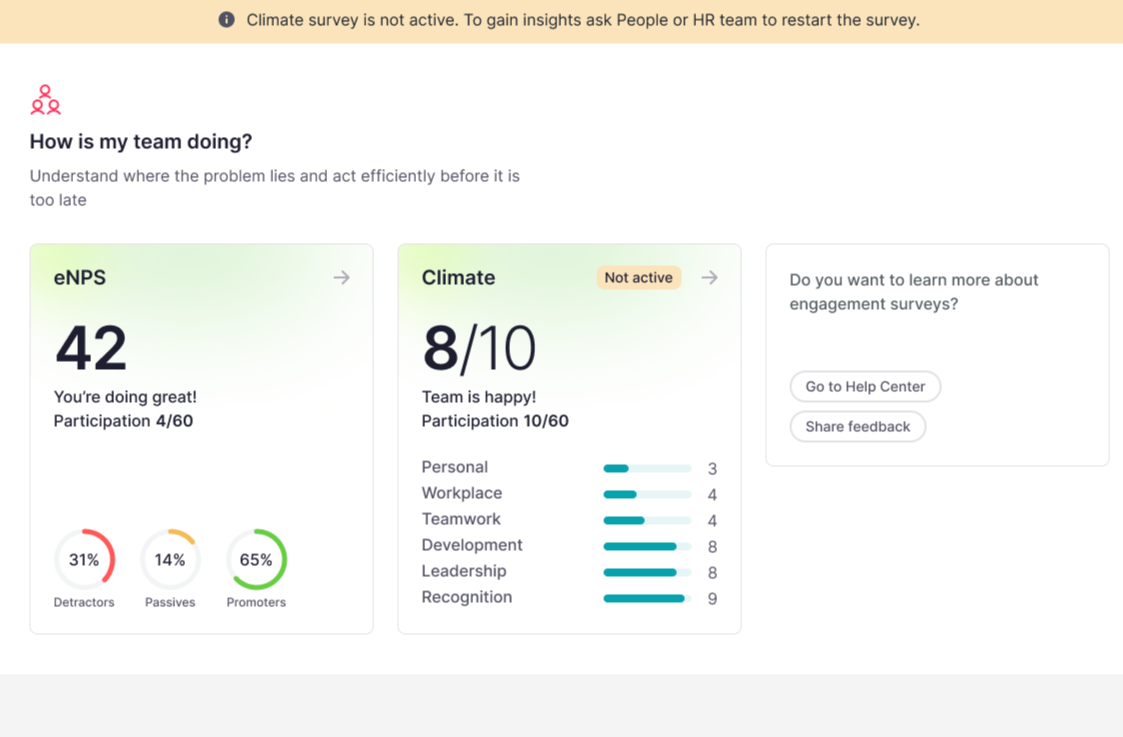
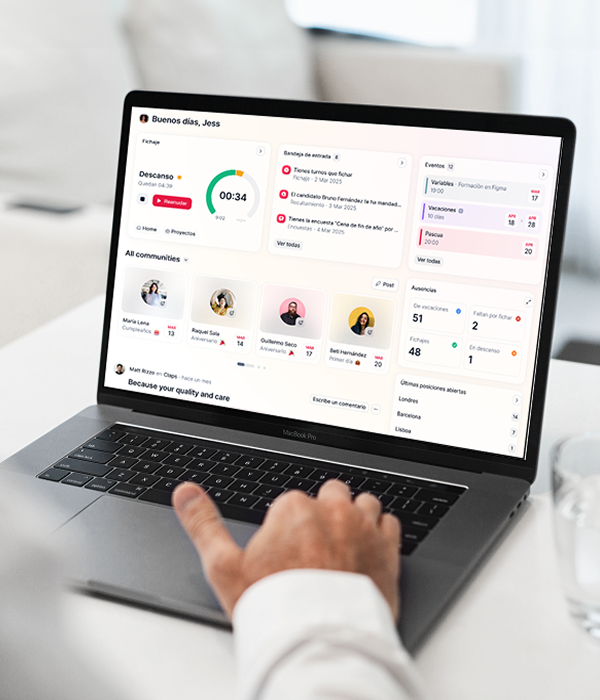
Factorial is an all‑in‑one business management platform that helps small and mid‑size companies manage people operations and employee engagement in one place. It combines core HR (like time off, documents, and contracts) with performance management software, surveys, and advanced analytics and HR reports, so you can see the full picture of your workforce instead of switching between several tools and trying to combine the data in a spreadsheet.
With Factorial, you can launch engagement surveys, set up performance reviews, track time and attendance, and analyze key people and performance metrics from a single, intuitive dashboard. This makes it easier to spot trends in satisfaction, burnout risk, or turnover and act before they become serious problems.
Pros:
- All‑in‑one platform that connects HR data, engagement, and performance.
- Simple, modern interface that employees and managers actually use.
- Strong fit for growing SMBs that need structure without enterprise complexity.
Cons:
- May include more HR features than a team that only wants surveys.
- Not designed as a point solution for large enterprises with many legacy systems.
Price
Factorial starts at $8 per month, per user. Custom quotes are available upon request. Get a demo of Factorial and see how it works for yourself.
2. Lattice
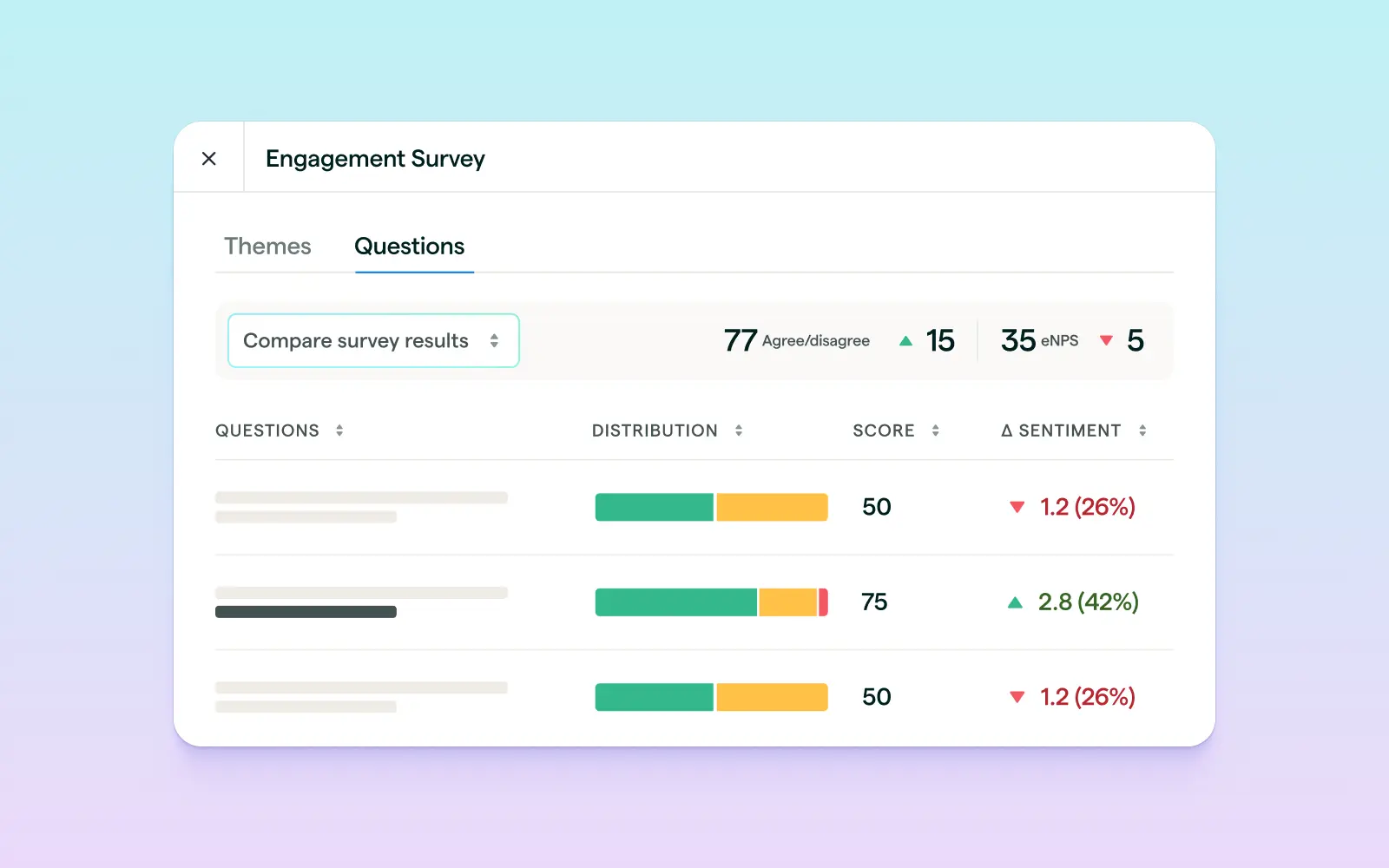
Lattice is a people platform that connects engagement surveys, performance reviews, goals, and feedback. Employees can set goals, receive feedback, and complete engagement surveys, while managers see trends for their teams in simple dashboards.
Because engagement and performance live in the same system, it becomes easier to understand how sentiment impacts results. For example, you can see whether teams with higher engagement scores also hit more goals or have lower turnover.
Pros:
- Strong link between engagement, goals, and performance reviews.
- Easy‑to‑use analytics for HR and managers.
- Integrations with tools like Slack and popular HRIS systems.
Cons:
- Can feel complex for small teams that only need surveys.
- Setup and pricing are more attractive for mid‑size and larger companies.
Price
Lattice starts at $11 with $4 per employee per month for the Engagement module.
3. Culture Amp
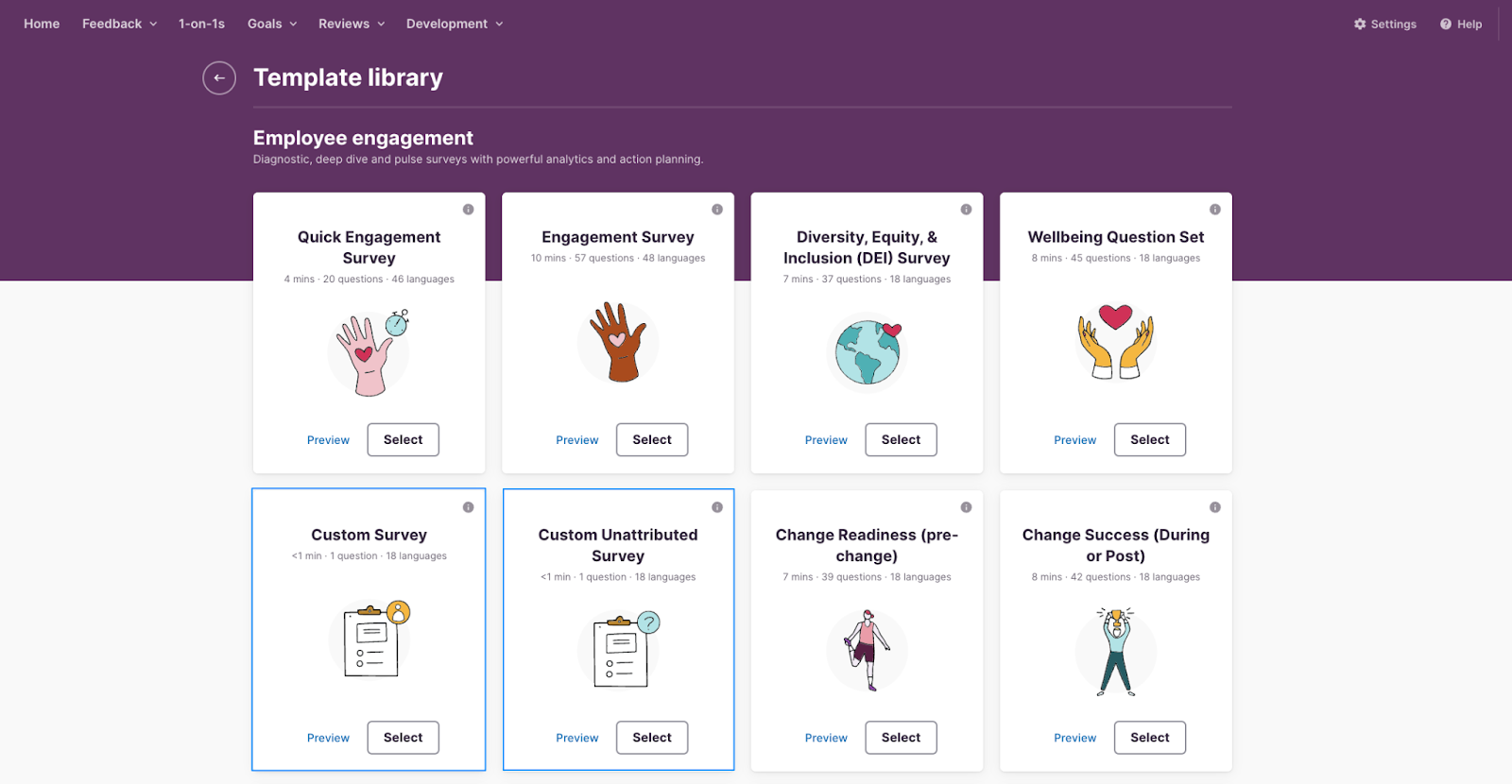
Culture Amp focuses on building a strong culture through engagement surveys, performance tools, and manager development. It offers expert‑designed survey templates, benchmarks, and action tips so HR teams do not have to start from scratch every time.
Managers can view results for their teams, compare them to benchmarks, and receive guidance on what actions to take next. This makes the data easier to understand and apply in everyday management.
Pros:
- Deep library of engagement surveys and benchmarks.
- Actionable guidance and learning content for managers.
- Performance tools that connect feedback to culture.
Cons:
- Reporting and configuration can feel complex at first.
- Minimum contract and pricing are better suited to mid‑size and larger companies.
Price
Pricing available upon request.
4. 15Five
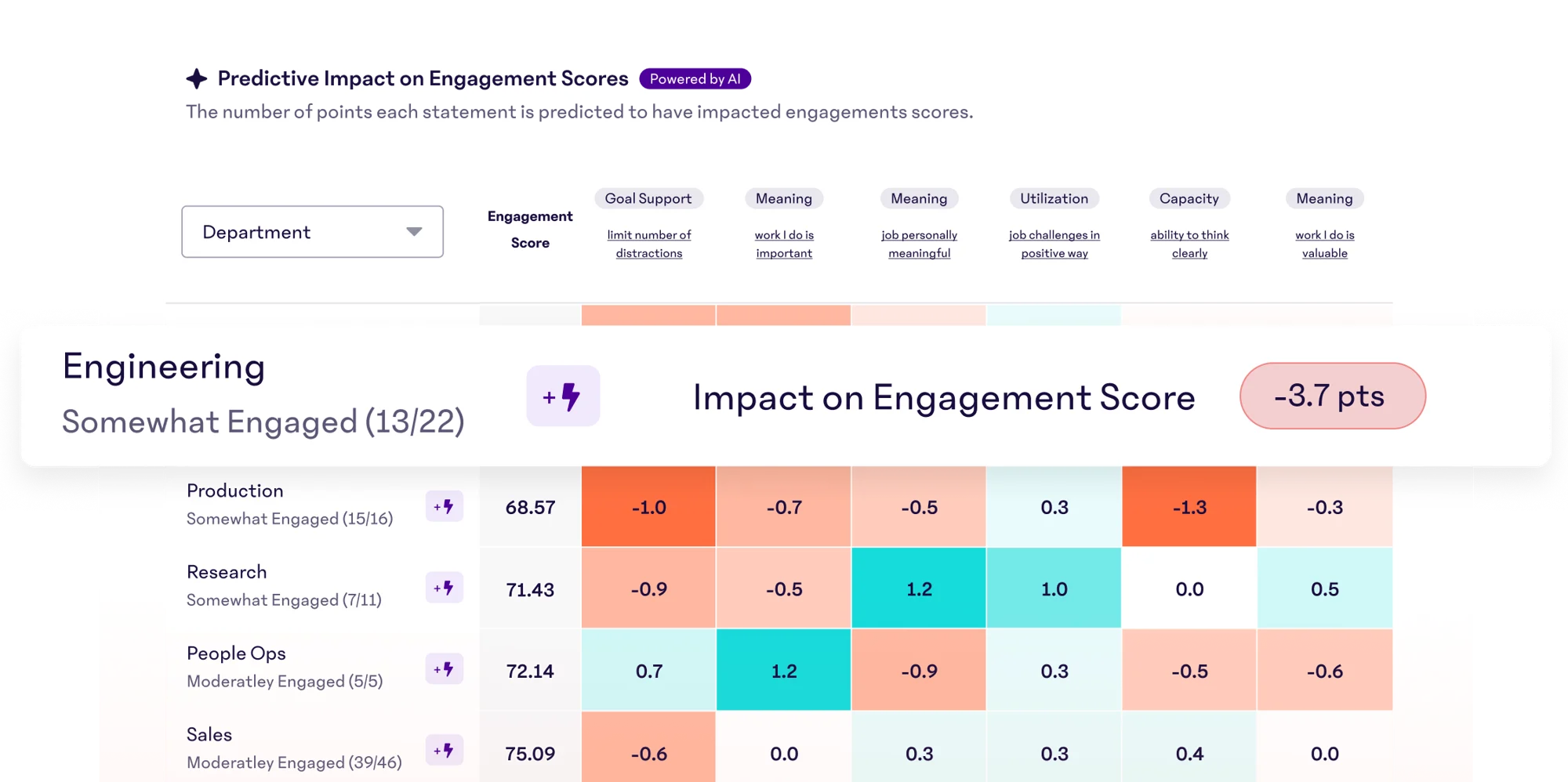
15Five is a performance and engagement platform built around frequent check‑ins and simple surveys. The name comes from the idea that employees can spend 15 minutes writing a weekly update and managers can spend five minutes reading it.
Teams use 15Five to share what they worked on, where they are blocked, and how they feel, which helps managers react quickly. The platform also includes OKRs and development tools so employees can see how their work ties to company goals and growth.
Pros:
- Friendly, simple design that encourages regular use.
- Strong focus on continuous feedback and manager‑employee conversations.
- Includes coaching and growth tools, not just measurement.
Cons:
- Analytics are less advanced than some heavy enterprise tools.
- Some workflows are less customizable than survey‑only platforms.
Price
15Five starts at $4 per user per month.
5. BambooHR
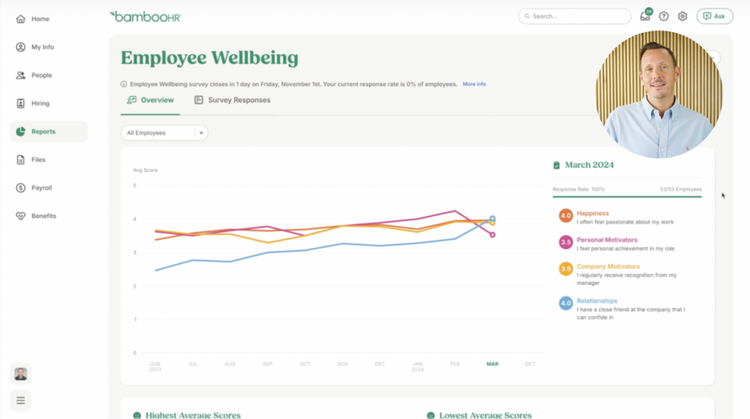
BambooHR is an all‑in‑one HR system that covers employee records, time off, hiring, payroll, and basic performance and engagement. For many smaller companies, it becomes the central hub for employee data and day‑to‑day HR tasks.
Its engagement options include performance reviews, basic feedback tools, and simple reporting. While it may not go as deep into engagement analytics as specialist tools, it works well for teams that want HR and engagement in one place.
Pros:
- Very intuitive and easy for HR teams and employees.
- Combines HR basics with performance and feedback features.
- Useful reporting for headcount, turnover, and other HR metrics.
Cons:
- Engagement features are not as advanced as survey‑first tools.
- May not be the best fit for very large or global enterprises.
Price
Starts at $10 per employee per month.
6. WorkTango
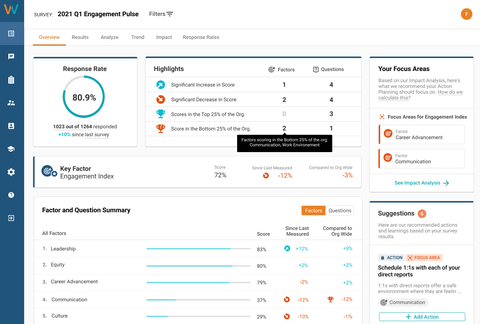
WorkTango is an employee engagement software that focuses on pulse surveys, analytics, and recognition. HR teams can send regular surveys, collect anonymous feedback, and view trends by team, location, or other segments.
The platform also includes a recognition and rewards module so companies can reinforce positive behaviors and celebrate wins. This combination helps you move from “measurement only” to real action and culture change.
Pros:
- Powerful survey engine with detailed analytics.
- Flexible templates and segmentation for deep insights.
- Built‑in recognition tools for a more positive culture.
Cons:
- Analytics and configuration take time to learn.
- Pricing is better suited to mid‑size and larger organizations.
Price
Pricing available upon request.
7. Bonusly
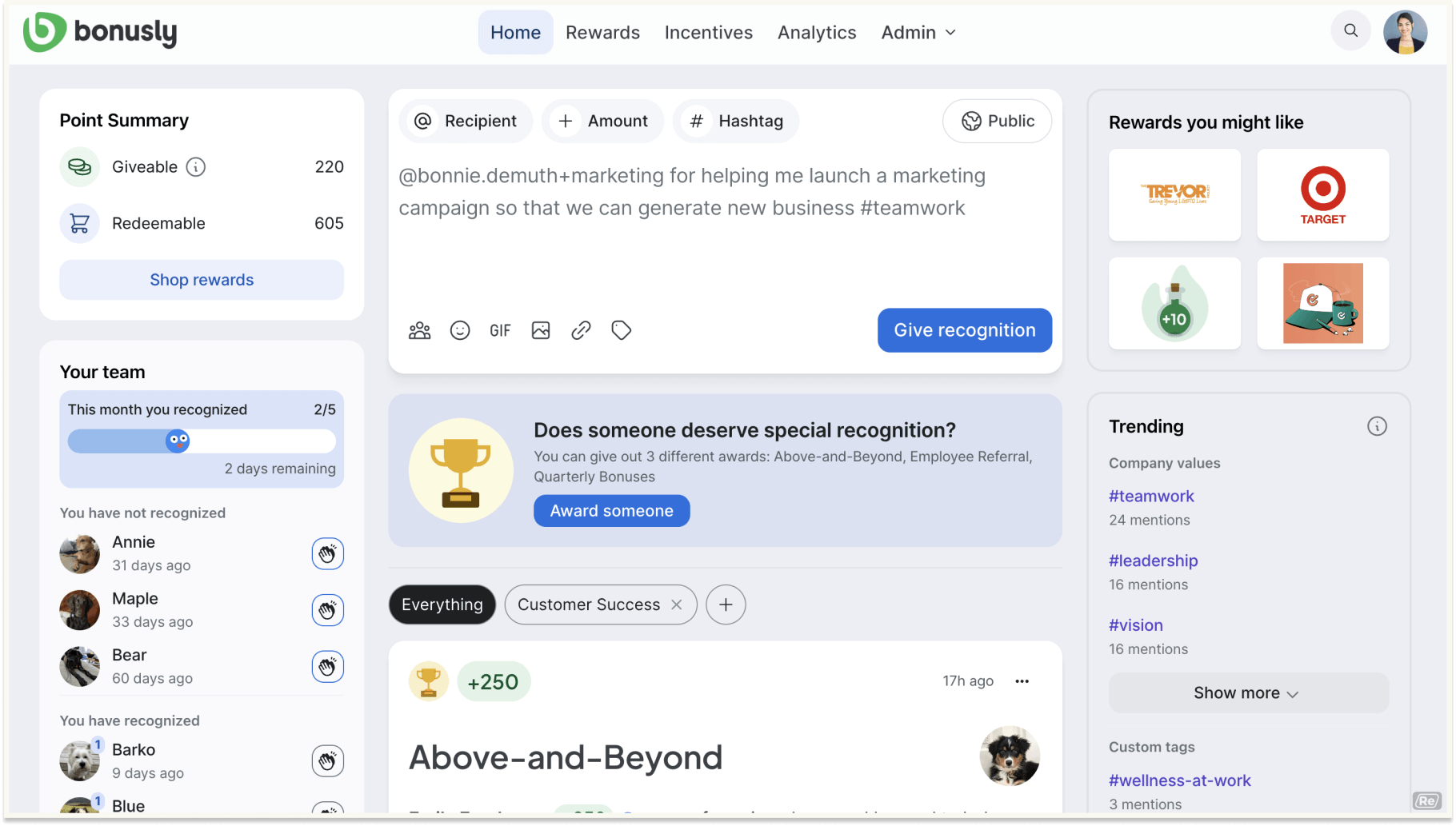
Bonusly is an employee engagement platform for peer‑to‑peer recognition and rewards. Employees give each other small bonuses tied to company values, and those bonuses turn into gift cards, donations, or other rewards.
Because recognition is public and frequent, employees feel noticed for their everyday work, not just big projects. It’s a simple way to increase appreciation and strengthen relationships across teams.
Pros:
- Very engaging and easy for employees to use.
- Encourages peer recognition, not just top‑down praise.
- Integrates with tools like Slack and Microsoft Teams.
Cons:
- Does not include full engagement survey or performance features.
- Reward budgets need planning so costs don’t surprise you.
Price
Bonusly has a free plan for small teams, paid plans start at $3 per employee per month with custom plans available for larger teams.
8. Achievers
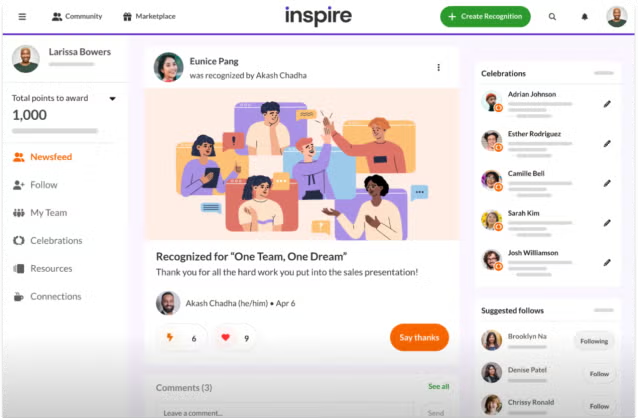
Achievers is an employee engagement software that focuses on recognition and rewards. It is used by many mid‑size and large companies. The platform has points, awards, and messages that align with company values and key behaviors.
HR can then analyze how recognition flows across the organization and how it relates to engagement, performance, and retention. This helps prove the impact of recognition programs on business results.
Pros:
- Strong global rewards marketplace and recognition tools.
- Analytics that connect recognition to key people metrics.
- Integrations with HR and communication platforms.
Cons:
- Configuration can feel rigid in some areas.
- Some reward options may not be available everywhere.
Price
Pricing available upon request.
9. SurveyMonkey
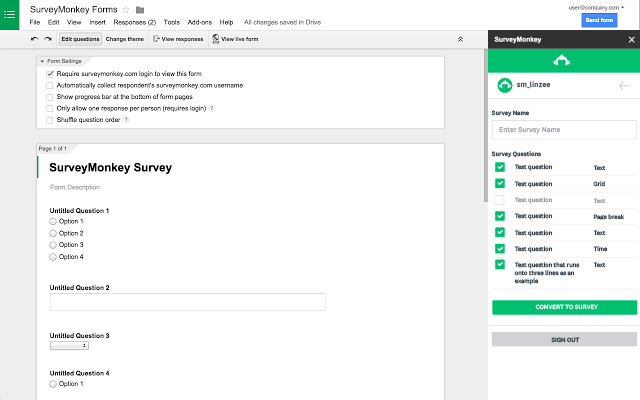
SurveyMonkey is a platform for making surveys that is widely used for collecting employee feedback. HR teams can create engagement, pulse, and lifecycle surveys (like onboarding and exit surveys) using templates and advanced question logic.
Although it does not provide full performance or recognition modules, it is very strong for collecting and analyzing feedback across the employee journey. You can also connect it with other tools to build your own engagement stack.
Pros:
- Easy‑to‑use survey builder with many templates.
- Strong analytics and export options for deeper analysis.
- Integrates with collaboration and HR tools.
Cons:
- Lacks built‑in performance and recognition features.
- Some advanced survey and reporting features require higher‑tier plans.
Price
Starts at €30 per user per month.
10. Leapsome
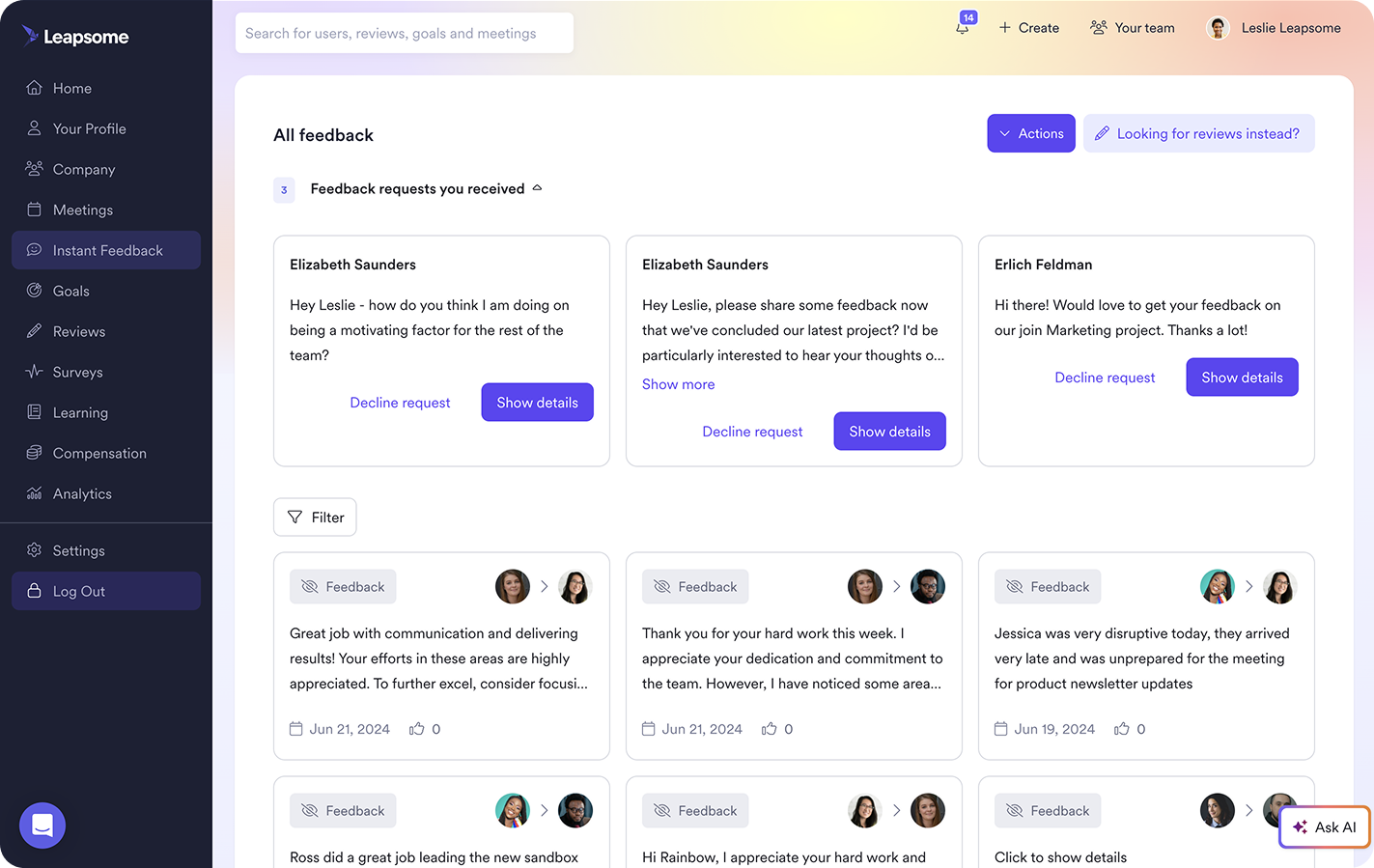
Leapsome combines engagement surveys, OKRs, performance reviews, and learning into one platform. This makes it attractive for fast‑growing companies that want to connect feedback, goals, and development.
You can run surveys, set team and individual objectives, and build learning paths for employees. Over time, this helps create a culture of continuous improvement and growth supported by clear data.
Pros:
- Strong mix of engagement, performance, and learning tools.
- Highly configurable workflows for reviews and surveys.
- Clean interface that teams adopt quickly.
Cons:
- Flexibility can feel overwhelming at the beginning.
- Some powerful features are only available on higher plans.
Price
Pricing available upon request.
How to choose employee engagement software
Choosing employee engagement software is easier if you follow a few clear steps. The aim is to pick a tool that fits your people and your company, not just the one with the most features.
1. Define your goals clearly
First, write down why you need engagement software.
Ask yourself:
- What people problems do we have right now?
- What is costing us the most time, money, or stress?
- What should success look like 12 months from now?
Typical goals:
- Lower turnover in key teams
- Better manager–employee communication
- Higher survey response rates
- More recognition and appreciation
- A clearer view of engagement based on data
Once you know your goals, you can ignore tools that do not support them.
2. Pick the right type of tool
Different tools focus on different things.
You might need:
- Survey‑focused tools to measure employee engagement and run pulse surveys
- Recognition‑focused tools to boost appreciation and rewards
- All‑in‑one HR and engagement tools to manage HR data, performance, and engagement together
If your HR basics are still on spreadsheets, an all‑in‑one platform can fix more than one problem at the same time.
3. List your must‑haves
Make a short list of what the tool must do and what would just be nice.
Common must‑haves:
- Easy survey builder or templates
- Anonymous feedback
- Clear dashboards for HR and managers
- Filters by team, country, or role
- Integrations with your HR and chat tools
This list keeps you focused during demos and comparisons.
4. Check ease of use and integrations
If the tool is hard to use, people will not use it.
Look for:
- A clean, simple interface
- Short, mobile‑friendly surveys
- Clear steps for managers to view results and act
- Helpful tips inside the tool
Also confirm:
- It syncs with your HR system
- It works with Slack, Teams, or email
- You can export data if needed
Good usability and integrations save time and increase adoption.
5. Compare price, value, and try it yourself
Price matters, but value matters more.
Compare:
- How the tool charges (per user or flat fee)
- What is included and what costs extra
- Any setup or training fees
Then think about:
- How much turnover costs you now
- How many hours of manual work you can save
- What a small boost in engagement could be worth
Before you commit, run a small trial with one or two teams. Use their feedback to adjust your setup and build a case for a wider rollout.
Why Factorial for employee engagement
While there are many good tools that you can use for measuring and improving employee engagement on the market, Factorial stands out for small and mid‑size companies that want to connect engagement with everyday HR work in a simple way that is scalable. Instead of managing separate systems for time off, contracts, surveys, and performance, you can centralize them all in one platform.
With Factorial, you can:
- Run engagement and pulse surveys to understand how people feel.
- Set up performance reviews and goals that support growth and clarity.
- Manage time off, shifts, and documents so daily operations run smoothly.
- Use analytics to spot trends in satisfaction, absenteeism, and turnover.
This combination helps you move from reacting to problems to building a proactive, people‑first culture. If you want to see how Factorial could work for your company, the best next step is to see the product in action.
Discover Factorial with a demo today to explore the platform, ask your questions, and design an employee engagement strategy that fits your team.
Disclaimer: The information presented on this page is based on publicly available sources. The comparisons between Factorial and other providers are intended solely for the illustration of the respective software features, pricing and functionalities. All information regarding features, prices, and integrations may be subject to change without prior notice. Factorial assumes no liability for the accuracy, completeness, or timeliness of the information presented. We recommend contacting the respective providers directly to obtain the most accurate and up-to-date information. All legal regulations regarding Spanish fair advertising and competition law are fully observed by us; if you have any concerns, please reach out to us. The comparisons presented do not constitute a final evaluation or recommendation for any provider, but serve solely as an informational source.