Saying goodbye to a team member is always hard to do. But what’s even harder is finding a replacement to fill their shoes. Employers, managers, and HR professionals know exactly how long and tedious the hiring process can be from creating the job posting to filtering through applications and interviews. However, the right ATS for HR departments can significantly reduce the length of the recruitment process and help you match with the best job candidates quickly. In this guide, we’ll be comparing the best applicant tracking systems on the market and answering the question, “Which ATS is best for HR?” That way, the guesswork is gone and you’re on your way towards an efficient hiring process.
What Is ATS for HR Departments?
An Applicant Tracking System (ATS) is recruitment software designed to manage and automate candidate tracking. It’s a must-have for HR teams that want to streamline their hiring process. Particularly for hiring managers that are looking to reduce their time-to-hire metric and fill critical roles ASAP. From sourcing and job posting to interview scheduling and reporting, an ATS covers the entire recruiting journey.
Furthermore, a 2023 study reported that “90% of Fortune 500 companies use an ATS.” If you’re ready to scale your team and find top talent, check out our top 10 best applicant tracking systems in 2026. You’ll find the right platform to enhance your recruitment process, reduce admin workload, and onboard new hires quicker than ever before.
Key Features of Applicant Tracking System for HR Departments
The best ATS platforms for HR departments solve both functional and strategic recruiting challenges. Here are some key features that you should look:
- Centralized applications: Automatically collects applications from job boards, career sites, and social media.
- Smart screening: Uses algorithms to sort resumes based on predefined criteria, surfacing the most relevant candidates.
- Candidate tracking: Keeps a record of every applicant’s journey—from interview to offer—helping recruiters avoid duplicates or missed steps.
- Team collaboration: Enables seamless communication between recruiters, HR teams, and hiring managers with features like feedback sharing, interview scheduling, and internal notes.
- Automated communication: Sends status updates to candidates automatically, enhancing the candidate experience.
- Recruitment analytics & reports: Gain valuable insights about your recruitment process to make the experience the best it possibly could be.
- Use of ease: Choose a platform that is easy to navigate and allows your team to leverage technology to its maximum capacity.
- Integrations: Ensure your recruitment process is connected with your daily tools to ensure all communication and core operations are centralized.
The Hidden Cost of Hiring without ATS for HR Departments
Most hiring teams don’t realize how much time and money gets lost before a single interview is booked. According to SHRM, the average cost per hire in the US is nearly $4,700. That number only grows when your process is scattered across spreadsheets and inboxes, and team communication is not connected and centralized.
The problem in hiring is rarely a shortage of applicants. The amount of applications recruiters hiring for corporate positions receive makes manual review genuinely unsustainable. With resumes arriving from multiple channels, i.e. from job boards, email, LinkedIn, candidate data ends up collected across platforms, not one platform. Qualified people get missed not because they were a poor fit, but because their application got buried.
Collecting feedback is a common bottleneck. When interview notes are all over the place, hiring decisions get delayed and consistency goes out the window. And when candidate updates are handled manually, people stop hearing back at all.
The last breakpoint is the handoff between recruitment and onboarding. When these two processes live in separate systems, HR teams end up re-entering the same employee data twice. This is an inefficiency that costs time and creates errors on a new hire’s very first day.
The best ATS for HR departments helps address each of these problems directly, replacing manual back-and-forth with automated, connected workflows across the entire hiring process.
Watch our video to understand the four biggest mistakes in recruitment and how you can fix them:
Benefits for HR Departments using ATS
The business case for an ATS for HR departments goes well beyond saving a few hours a week. Here is what organizations consistently gain after making the switch.
Faster Time-to-Hire
More than 86% of HR professionals say their ATS has helped them hire faster and more effectively. Automated job posting, resume parsing, and interview scheduling cut out the manual back-and-forth that slows most hiring pipelines.
Lower Cost Per Hire
Every day a role sits vacant, it costs your business money. An ATS helps HR departments shorten the hiring cycle by automating the most time-consuming tasks like screening, scheduling, and status updates. That way your team spends fewer hours on admin and more time on the work that actually matters. A shorter, more efficient process means a lower cost per hire overall.
Higher Quality of Hire
When resumes are parsed automatically and filtered by the criteria that matter most to your role, the best-fit candidates rise to the top faster. Your team spends less time sifting through unqualified applications and more time talking to people who are actually a good match. Over time, better screening leads to better hires and fewer costly mistakes.
A Better Candidate Experience
Candidates form an impression of your company from the very first interaction. When applicants receive timely updates at every stage, including rejections. Candidates can walk away with a positive view of your brand, even if they didn’t get the job. An ATS handles this automatically, so no one falls through the cracks and your employer reputation stays intact.
Seamless Team Collaboration
Hiring rarely happens in isolation, which is why an ATS for your HR team gives everyone involved one shared space to review profiles, leave structured feedback, and align on decisions. No more hunting down opinions across Slack threads, emails, and chats. Feedback is tied directly to the candidate, visible to the whole team, and easy to act on.
Built-In Analytics and Compliance
With all your hiring data in one place, you can see exactly where your pipeline slows down, which sourcing channels perform best, and how your team’s time is being spent. That visibility makes it much easier to improve your process over time. Built-in tools also help you stay on top of data retention, equal opportunity requirements, and audit documentation without any extra admin work.
Top 10 ATS Software Platforms for HR Departments in 2026
Not all HR ATS platforms are built the same. Some are designed for small teams that need a simple, affordable tool to manage a handful of hires per year. Others are built for enterprise organizations running high-volume hiring across multiple locations. The 10 platforms below cover the full range, so whether you are a startup hiring your first employees or a growing company scaling fast, there is an option here that fits your needs and budget.
1. Factorial
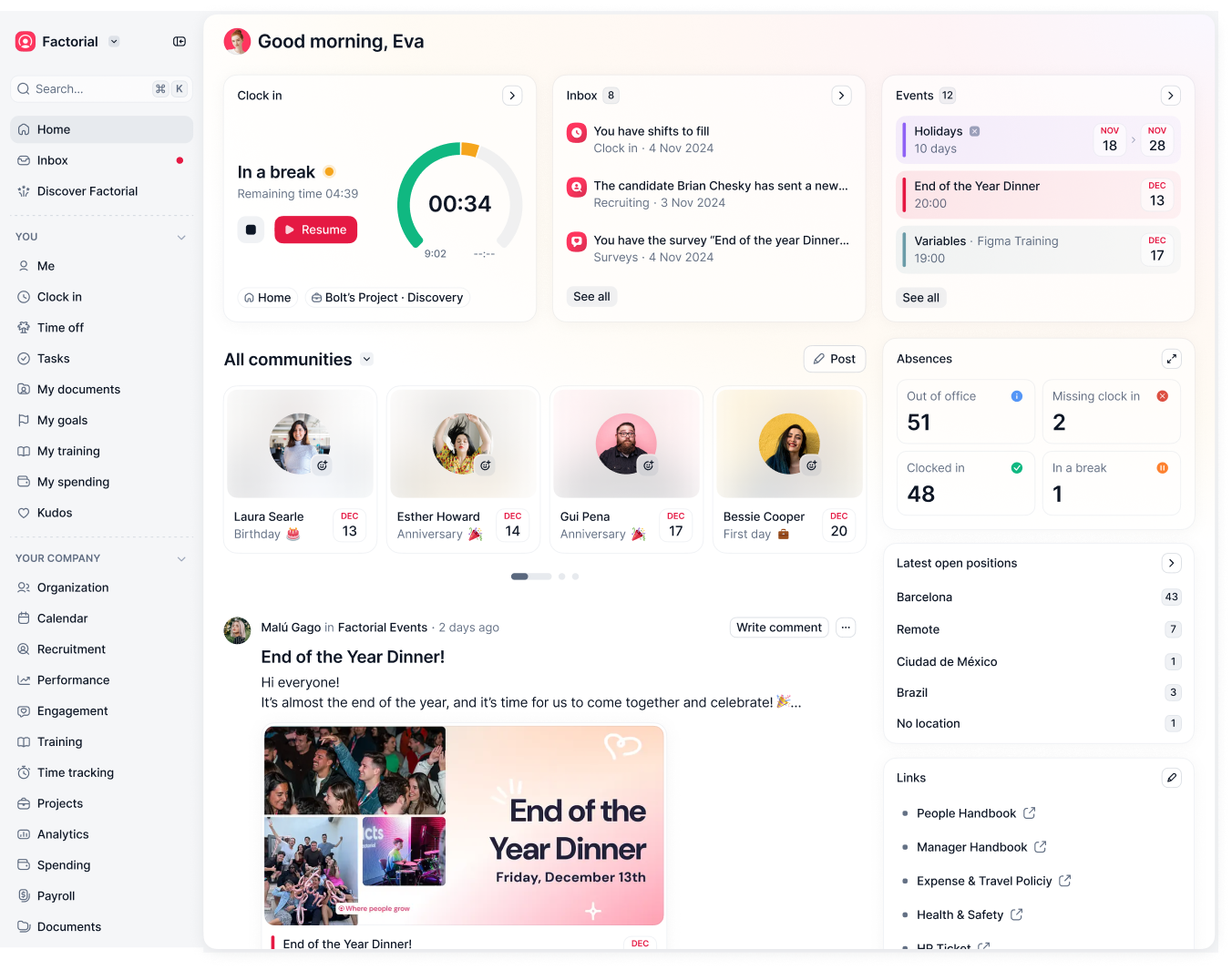
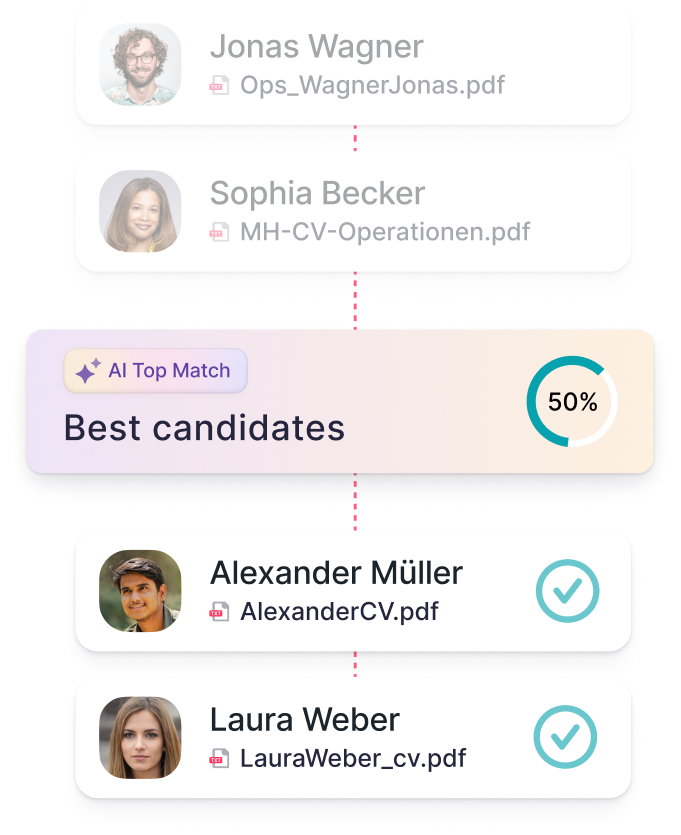
Factorial offers more than just business management software. It also offers a powerful built-in Applicant Tracking System. With its user-friendly interface, it’s designed to make the recruiting process easier and more efficient. Additionally, Factorial’s recruitment module has built-in AI features to filter through candidates and match you with top talent.
When using Factorial’s ATS software, you can expect advanced filtering algorithms, automated CV parsing, and real-time analytics. You can publish job descriptions that are automatically uploaded to multiple job boards, schedule interviews, and track candidates’ progress, all from one centralized platform.
🚀 From job creation to multi-posting and automated CV analysis — Factorial covers it all. Get a free demo.
All these features (plus more!) make it a strong choice for businesses looking for an all-in-one business management solution. Factorial provides your team with recruitment tools, performance management, time tracking, and PTO management, as well as payroll and expense management.
Pros
- Easy-to-use ATS embedded in an all-in-one HR platform
- AI‑enhanced CV filtering and centralized candidate data
- Seamless link between recruitment, org chart, and onboarding
Cons
- Recruiting features are less advanced than specialist ATS tools
- Integrations and automation depth can be limited versus enterprise platforms
- Best suited to SMBs; may not scale to very complex, high-volume hiring
Price
Core plan starts from $8 per employee per month. Get a custom quote tailored to your needs with a free demo call. See Factorial in action!
2. JazzHR
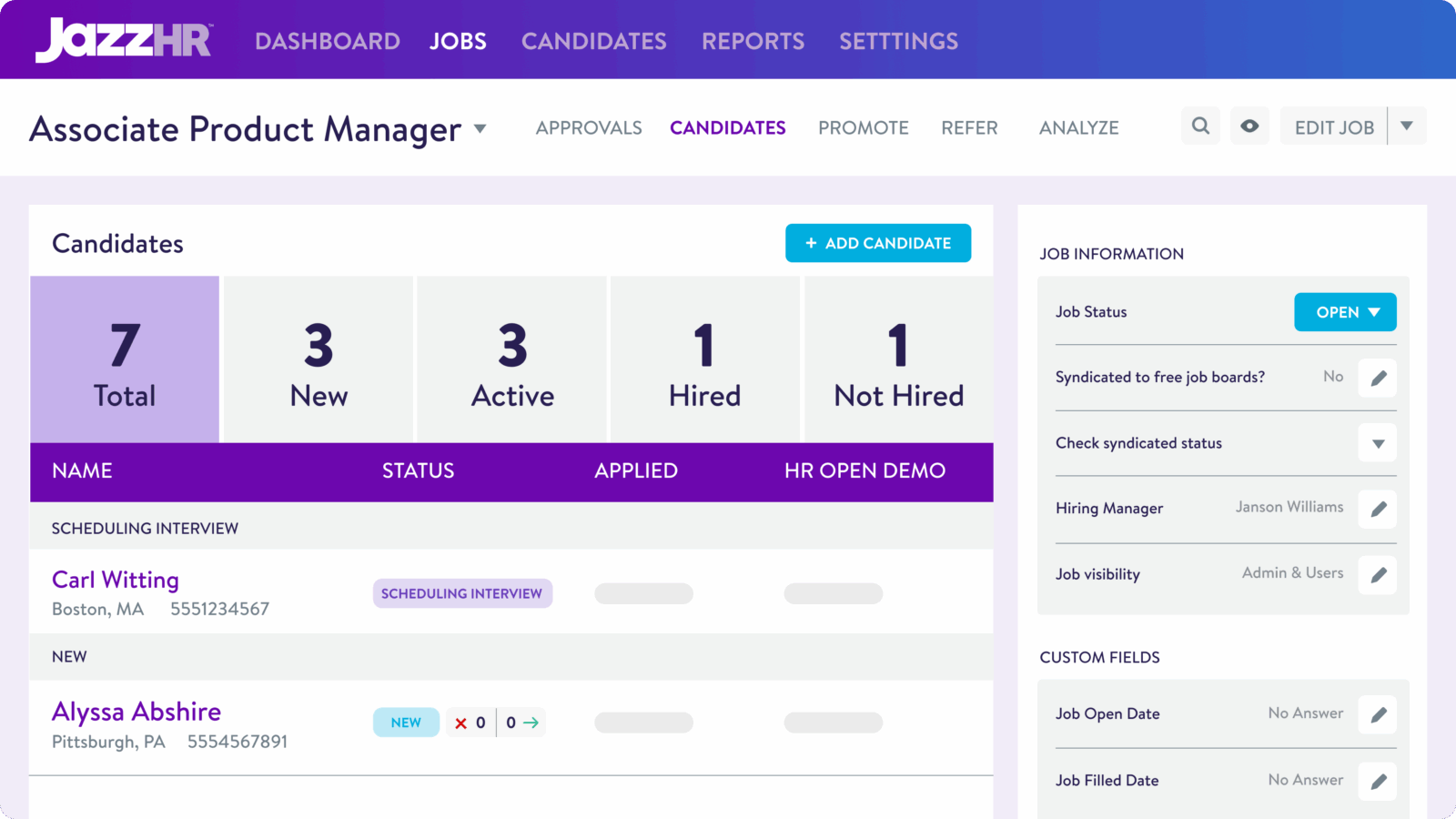
JazzHR is a popular applicant tracking system software that focuses on smart hiring. It offers customizable capabilities to tailor your job postings, automated resume screening, and tools for scheduling interviews. Additionally, JazzHR provides users with recruitment analytics to track and measure key metrics such as candidate quality.
Pros
- Budget-friendly ATS designed for small and growing businesses
- Simple, easy-to-use interface with quick setup
- One-click job posting and solid core automation features
Cons
- Reporting and analytics are fairly basic in standard plans
- Limited advanced features and integrations compared to larger ATS platforms
- Some workflows, search, and performance can feel clunky at scale
Price
Monthly plans start from $350 per month. Starter plan for startups from $1,000 per year.
3. Greenhouse
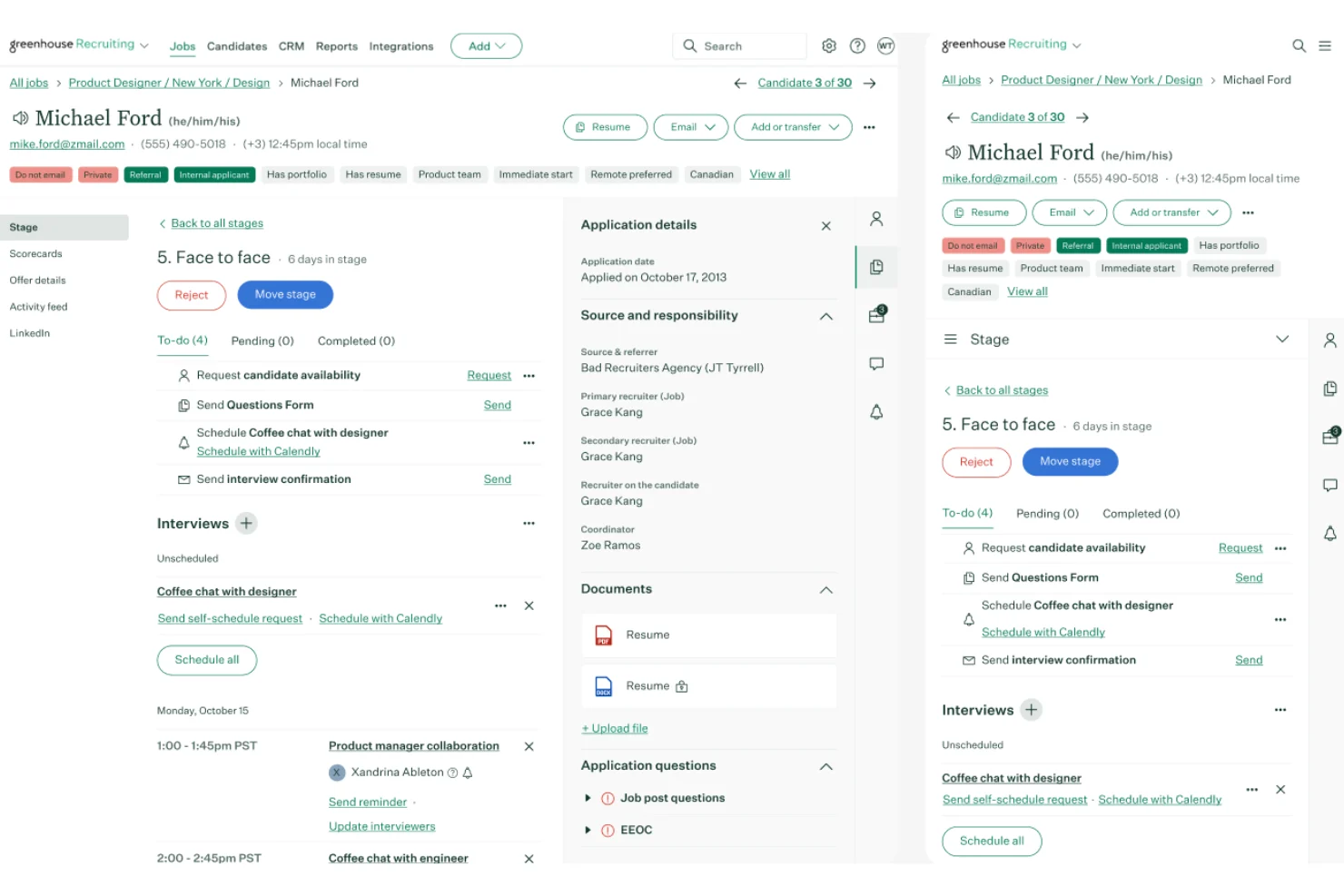
Greenhouse stands out for its user-friendly interface, customizable interview kits, and seamless job board integrations.
It offers smooth candidate management and a standout candidate experience, thanks to automation and multi-channel posting. Moreover, it provides multiple tools to connect you to the best candidate through a structured hiring process to reduce bias and improve hire quality.
Pros
- Structured hiring framework to reduce bias and improve consistency
- Intuitive, recruiter-friendly interface and workflows
- Extensive integrations and end-to-end hiring platform
Cons
- Can be complex and overwhelming for smaller teams
- Noticeable learning curve for new users
- Pricing targeted more at mid-size and enterprise organizations
Price
No public pricing info available.
4. iCIMS
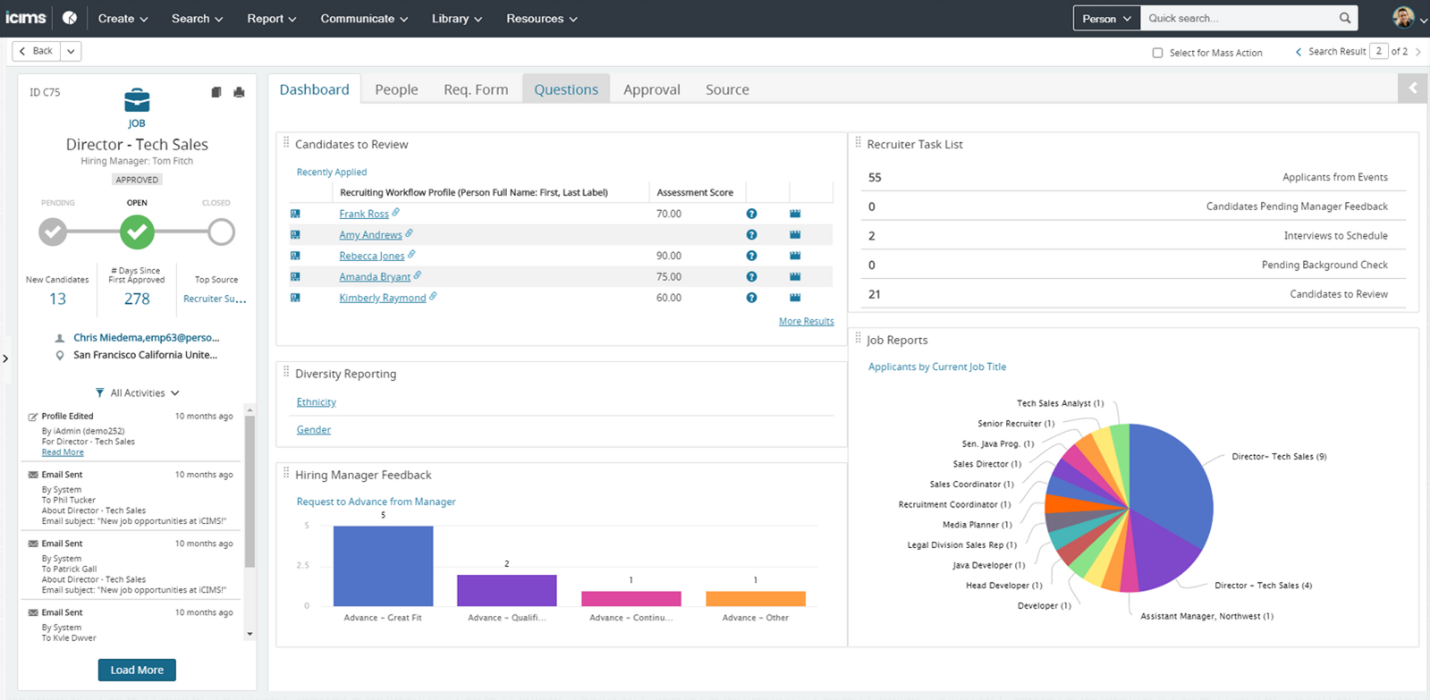
iCIMS provides a full talent acquisition suite that is an ATS and CRM system in one platform. It simplifies candidate sourcing, posting jobs, and supporting your talent acquisition team. Additionally, it offers onboarding features to help welcome your new hires through software integrations.
With an ATS system this powerful, your overall recruitment process will become more efficient. Ultimately, saving you time and reducing admin work for your team.
Pros
- Highly configurable, enterprise-grade applicant tracking
- Strong AI-powered automation and talent matching
- Extensive integrations and global scalability
Cons
- Complex to implement and manage for smaller teams
- Pricing and packaging oriented toward large enterprises
- Interface and workflows can feel heavy compared to lighter ATS tools
Price
No public pricing info available.
5. Zoho Recruit
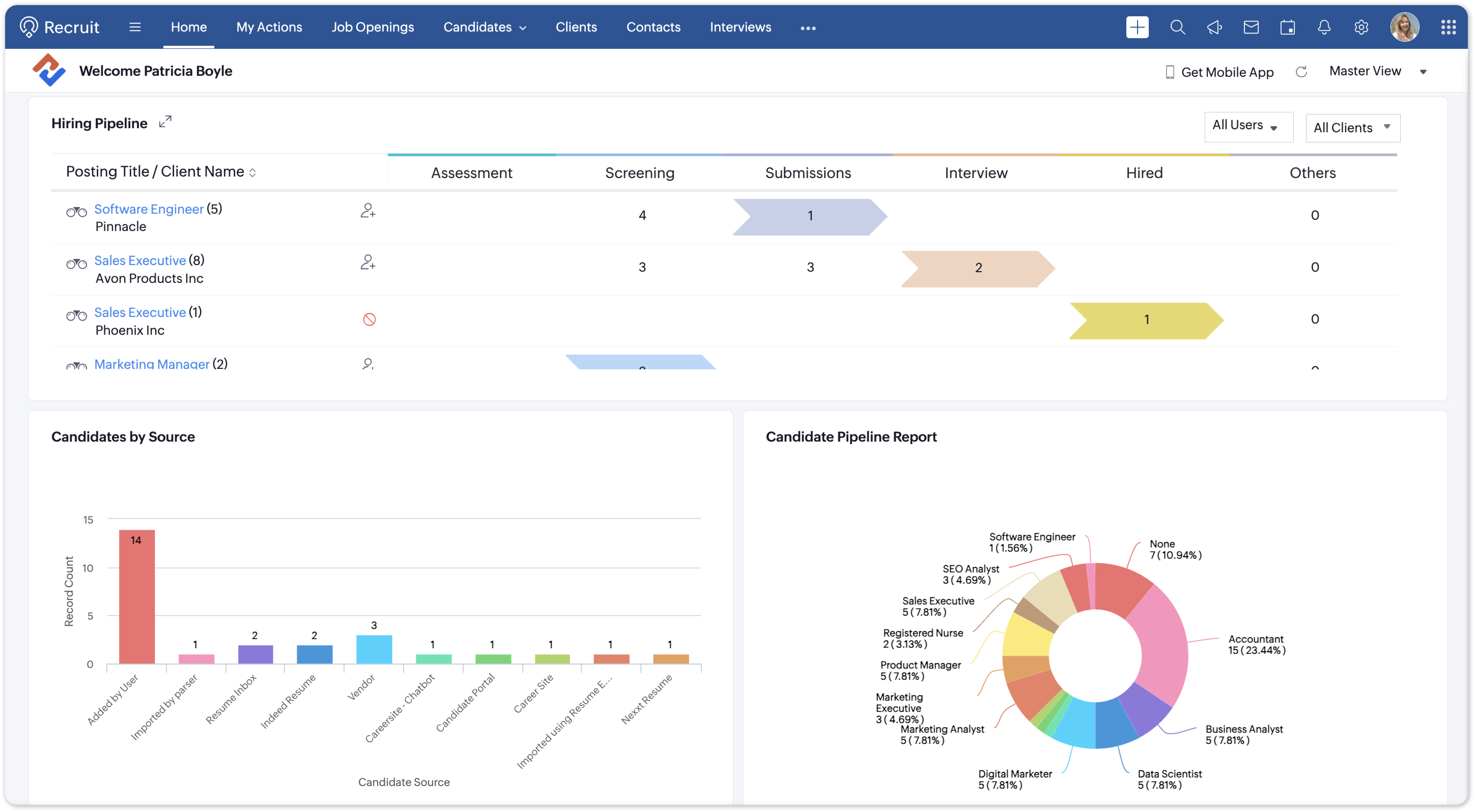
Zoho Recruit is a great ATS system for smaller organizations that have smaller budgets to work with. It’s also ideal for businesses that are already part of the Zoho ecosystem. Zoho Recruit supports team efforts by simplifying hiring workflows, including candidate tracking and scoring candidates to find which applicant is the best match. Additionally, features include automated resume parsing and job posting template creation to ensure efficiency and save your team time.
Pros
- All-in-one ATS and recruitment CRM
- Broad job board reach and AI-powered candidate matching
- Highly customizable workflows and strong automation features
Cons
- Integrations with non-Zoho tools can be limited or complex
- Interface and usability can feel less polished than newer ATS tools
- Support responsiveness and SLAs can be inconsistent
Price
Free plan available. Paid plans start from $30 per recruiter per month.
6. Workable
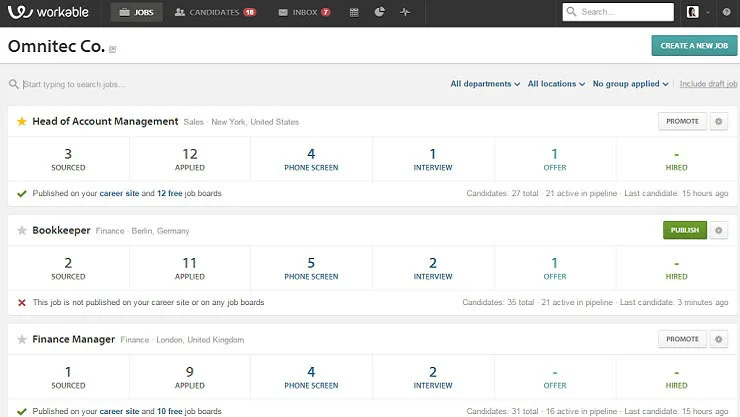
Workable is an all-in-one recruiting software designed to streamline every stage of the hiring process. It offers advanced features like AI-powered candidate sourcing, customizable pipelines, and one-click job posting to over 200 job boards. Workable also supports team collaboration with built-in messaging, evaluation tools, and automated workflows to move candidates through the funnel efficiently.
Additionally, its reporting and analytics tools help hiring teams track performance and improve recruitment strategies over time. It centralizes and analyzes the entire employee lifecycle so you can make strategic changes to enhance your workplace.
Pros
- Intuitive, easy-to-learn interface
- Strong job posting and multi-board reach
- Helpful AI-powered sourcing and screening tools
Cons
- Pricing can be high for smaller teams
- Limited customization and flexibility in workflows
- Some missing or basic features versus enterprise ATS tools
Price
Plans start from around $299 per month depending on number of employees and features chosen.
7. Lever
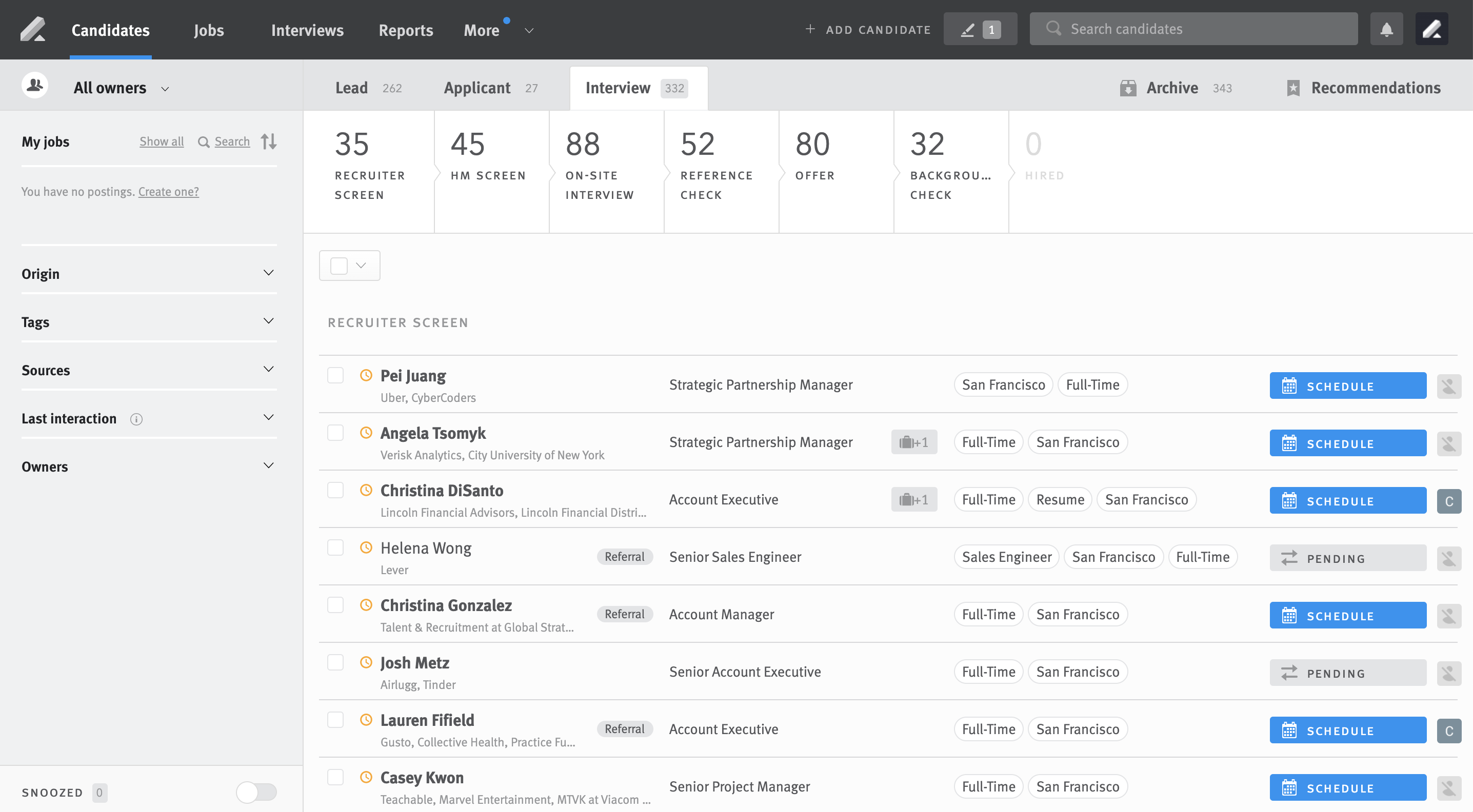
Lever is well-suited for high-volume hiring as it centralizes candidate data with the option to add customizable tags to categorize candidates. Its platform was designed to encourage relationship-building throughout the hiring process to give recruitment a human touch. Additionally, the platform offers personalized communication templates and tailored reporting tools to track key metrics.
Pros
- Modern, intuitive interface for recruiters and hiring managers
- Built-in ATS plus native CRM for talent nurturing
- Strong collaboration, automation, and scheduling tools
Cons
- Higher, less transparent pricing than many ATS tools
- Limited customization and some reporting/analytics gaps
- Occasional performance and support quality issues
Price
Pricing only available through a custom quote.
8. Bullhorn
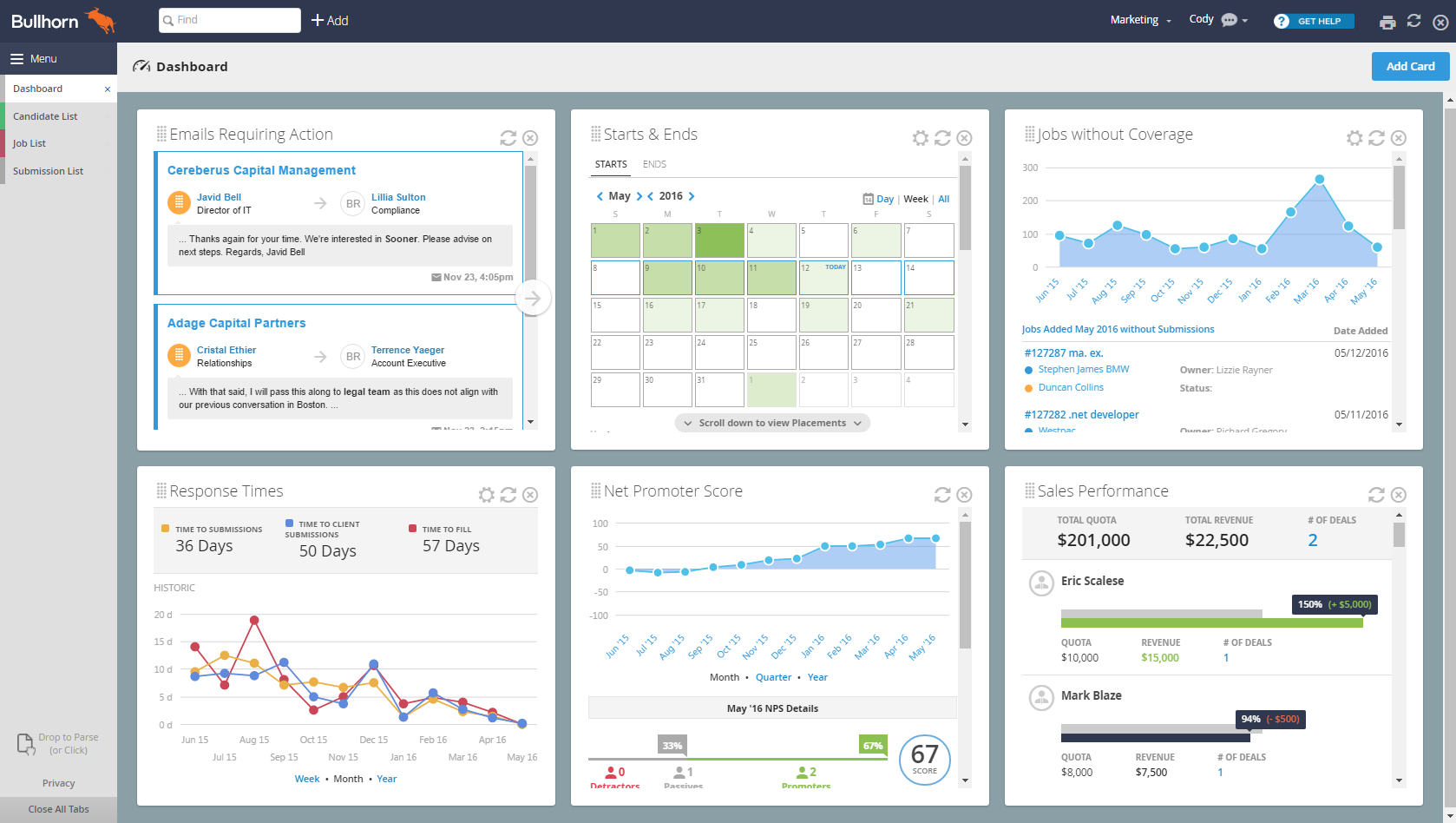
Bullhorn is a popular ATS system for staffing agencies that is also well-suited for corporate HR teams. It offers AI-powered tools to enhance efficiency and create an effective hiring process. Moreover, Bullhorn provides a centralized candidate database, candidate tracking, and tools for scheduling interviews.
With just a few clicks, you can create custom reports to analyze your recruitment process. This valuable information makes it easier to make well-informed recruitment decisions. Unlike the other top ATS tools, Bullhorn doesn’t offer any additional HR features like a PTO tracker or payroll.
Pros
- User-friendly, recruiter-focused interface
- Strong applicant tracking and CRM in one platform
- Efficient candidate data entry and follow-up tools
Cons
- Higher pricing than many other ATS providers
- System performance can be slow at peak times
- Interface can feel outdated compared to modern tools
Price
Starter plan from $99 per user per month.
9. SmartRecruiters
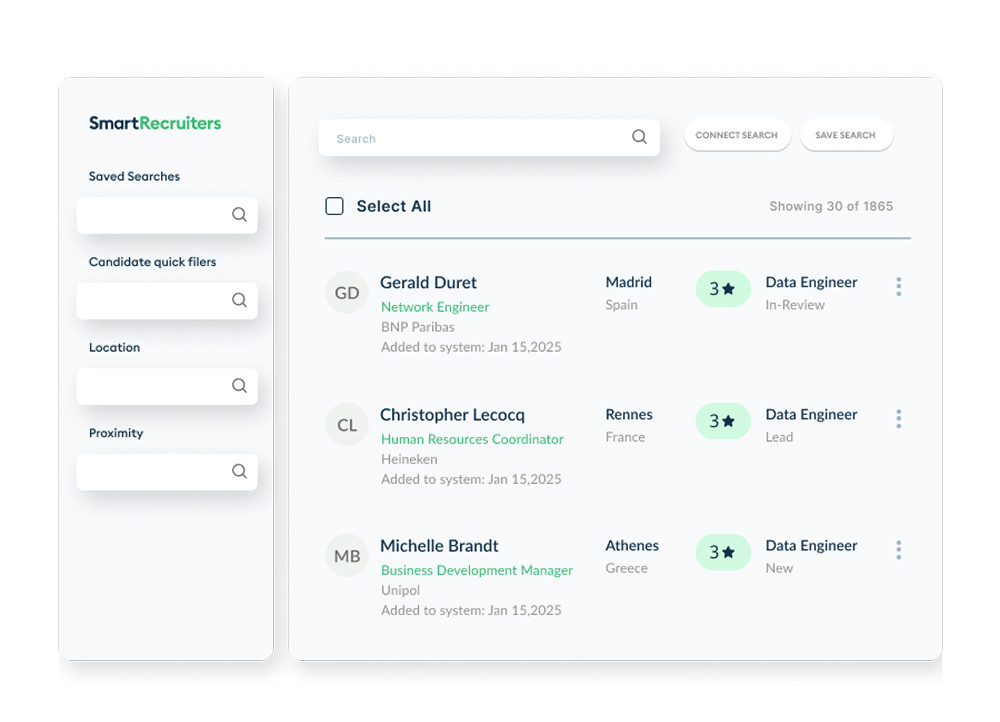
SmartRecruiters is tailored for enterprise-level recruiting. Its offers a flexible platform with a wide range of options for 3rd-party integrations that include background checks or onboarding solutions.
Also, it combines multi-posting, AI-powered sourcing, and seamless collaboration between hiring teams. Additionally, users report that SmartRecruiters is an intuitive system, even for those who aren’t tech-savvy.
Pros
- User-friendly, enterprise-grade ATS
- Strong multi-channel sourcing and marketplace
- Global, scalable platform with robust integrations
Cons
- Can be complex and heavy for smaller teams
- Reporting quirks and data cleanliness issues
- Configuration and customization limitations
Price
Essentials plan starts at $14,995.
10. BambooHR
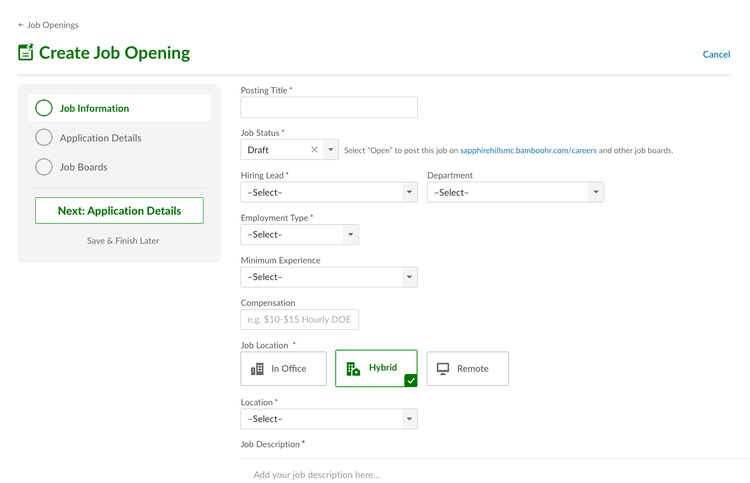
BambooHR’s ATS is simple yet powerful and comes as part of their broader HRIS offering. It’s recruiting software allows you to create custom reports to check key recruitment metrics and automate publishing open positions to multiple job boards.
Widely used by SMBs, it helps centralize applications, schedule interviews, collect feedback, and move successful candidates straight into the HR system. BambooHR’s ATS and HR tools make it a powerful tool for teams looking to centralize all their company workflows and documents.
Pros
- User-friendly ATS and workflows
- Integrated job posting and candidate sourcing
- Strong link between hiring and onboarding
Cons
- Pricing and add-on structure
- Limited depth for complex recruiting needs
- Integration and mobile limitations around hiring
Price
Core plans start at $10 per employee per month.
Choosing the Right ATS for HR Departments: Key Takeaways
Finding the best ATS for HR departments can feel overwhelming. Your final decision should depend on your company’s size, recruitment volume, desired integrations (like with HRIS or communication tools), and budget. Take into consideration the needs of your talent acquisition team and ask yourself, what features do they need to streamline the recruitment process? Do they need reporting and analytics tools? Do they need platform that stores applicants in a talent pool?
For many businesses, an ATS platform may not be enough to manage their needs. They need a tool that will help them throughout the entire employee lifecycle journey – from candidate sourcing to offboarding. A popular choice a full-featured HR platform with ATS features, payroll, and more is Factorial.
👉 See Factorial in action with a product specialist.
Its platform includes an ATS which simplifies the hiring process with its built-AI features that writes job descriptions, post open roles on multiple job boards, and filters through resumes. Factorial is the only tool you’ll need to manage your business and team. Transform your hiring workflows today!
The information presented on this page is based on publicly available sources, but not limited to bamboohr.com, smartrecruiters.com, bullhorn.com, lever.co, zoho.com, workable.com, icims.com, jazzhr.com, Capterra public reviews, G2 public reviews, and Trustpilot public reviews. The comparisons between Factorial and other providers, are intended solely for the illustration of the respective software features, pricing and functionalities. All information regarding features, prices, and integrations may be subject to change without prior notice. Factorial assumes no liability for the accuracy, completeness, or timeliness of the information presented. We recommend contacting the respective providers directly to obtain the most accurate and up-to-date information. All legal regulations regarding spanish fair advertising and competition law are fully observed by us; if you have any concerns, please reach out to us. The comparisons presented do not constitute a final evaluation or recommendation for any provider, but serve solely as an informational source.
FAQs
Recruiters often use ATS platforms, video interview tools, job boards (e.g., LinkedIn, Indeed, etc.), and skill assessment platforms.
An ATS platform can help HR teams in various ways. It collects applications from different sources (career pages, job boards, referrals), filters them based on set criteria, and helps recruiters manage every step of the process from screening to hiring.
An ATS saves time, improves candidate experience, reduces human error, enhances collaboration, and provides actionable recruiting data.
Evaluate your company size, number of hires, integration needs, and budget. Always test the interface and customer support before committing.
No, but it quickly becomes essential when managing multiple open roles. It helps structure your processes, improve hiring quality, and save time. An ATS that is included in your HR management software is a powerful tool that can reduce your HR team's workload.
Factorial is the best HR ATS tool for the recruitment process. Its platform helps centralize all candidate communication, automate tedious tasks, and improve the overall quality of your hiring process.