Struggling to manage a high volume of resumes and track applicants effectively? An Applicant Tracking System (ATS) automates and centralizes your entire hiring process. This guide explores the top ATS software solutions for 2026, detailing the features that save time, reduce administrative burdens, and help you identify the best candidates faster. From AI-powered resume screening to seamless team collaboration, discover the right tool to elevate your recruitment strategy and build a stronger workforce.
Key Facts
- An Applicant Tracking System (ATS) is software that automates the recruitment process, from posting jobs to screening resumes and extending offers.
- The global Applicant Tracking System market is projected to grow from $18.57 billion in 2026 to $34.83 billion by 2034, according to Fortune Business Insights.
- According to SHRM, the average cost-per-hire in the U.S. is nearly $4,700, a cost that ATS platforms can help reduce.
- Organizations using an ATS can reduce their average time-to-hire by up to 40% compared to manual processes, according to Frankland Automation.
What is an Applicant Tracking System?
An Applicant Tracking System (ATS) is a software tool that helps companies manage their hiring process more efficiently. It acts as a central hub where all job applications, resumes, and candidate information are stored and organized. The best applicant tracking system includes built-in AI features to speed up your recruitment process. Overall, an efficient ATS system helps provide a structured hiring process, matches you with the best applicant, and includes visuals to see an overview of your candidates’ progress throughout the process. Recruitment software further enhances these capabilities by promoting collaboration and data-driven hiring decisions.
In simple terms, an ATS makes it easier for companies to manage job applications, find the right candidates, schedule interviews, collaborate with team members, and make informed hiring decisions while ensuring data security and privacy compliance.
Here’s how an ATS works:
While specific functionalities vary, the core features of a modern ATS are designed to automate and structure the hiring pipeline.
Job Posting and Application Management
Applicant tracking systems let companies create and post job openings on different platforms and job boards. They collect and stores all the applications and resumes that are submitted, making it easier for hiring teams to keep track of them.
Resume Parsing
ATS software can automatically read and extract important information from resumes. This resume parsing software saves time because it doesn’t require manually entering data. All essential information will be auto-filled so you can focus on finding qualified candidates and not sorting through resumes.
Candidate Screening and Evaluation
ATS platforms help filter and evaluate candidates based on specific criteria and qualifications. Recruiters can search for keywords in resumes to find the most suitable candidates. This matches you to the best applicants faster and creates a more efficient hiring process.
Interview Scheduling
Applicant tracking systems help schedule and coordinate interviews with candidates. They send invitations, manages availability, and even sends reminders. This streamlines and enhances the recruiting process for both candidates and employers.
Collaboration and Communication
ATS platforms allow team members involved in the hiring process to share candidate information, feedback, and notes. They also provide a way to communicate with candidates through email or messages within the system.
Reporting and Analytics
An applicant tracking system (ATS) can generate reports and provide insights about the hiring process. For example, it can show how long it takes to hire someone, where candidates come from, and other useful data to improve hiring strategies. Strong reporting capabilities are crucial for ATS platforms to have, so employers can make the necessary adjustments to have a more efficient hiring process.
Compliance and Data Security
ATS systems prioritize keeping candidate data secure and complying with privacy regulations, like GDPR.
How to choose an applicant tracker for your organization
Selecting the right ATS is a critical decision that impacts hiring efficiency, candidate experience, and data management. A systematic approach ensures you choose a platform that aligns with your specific organizational needs and scales with your growth.
In order to make an informed decision, evaluate each applicant tracker based on the following criteria.
- Identify your needs: Assess your hiring process and determine what features you require in an ATS software or hiring platform.
- Consider scalability and customization: Check if the ATS can grow with your organization and be customized to fit your workflows.
- Look for user-friendly options: Choose an ATS with an easy-to-use interface and a smooth implementation process.
- Ensure integration capabilities: Verify if the ATS can integrate with your existing HR tools and systems or additional recruitment software to make your recruitment process easier, like Ringover, which embeds Voice over Internet Protocol (VoIP). Ringover is ideal for companies like staffing agencies looking for an easy-to-use and scalable solution without the need for traditional phone hardware.
- Prioritize data security and compliance: Make sure the ATS has robust security measures and complies with relevant data protection regulations.
- Evaluate customer support and training: Assess the level of support provided by the ATS provider and the availability of training resources.
- Consider pricing and ROI: Evaluate the pricing structure and determine the value and return on investment the ATS offers. For more information on how to calculate the ROI of a tracking system, skip to the end of this article.
By considering these factors, you can choose an ATS that meets your needs, enhances your hiring process, and provides a positive return on investment.
Why do you need an Application Tracking System?
Whether you work in the HR department of a small to medium-sized company or a larger corporation, you know the hassle of sifting through countless resumes to find the ideal candidate. This is where the benefits of a candidate tracking software really come in handy. An ATS delivers measurable value across three key areas of the recruitment cycle:
Job openings
Understaffed at one of the physical store locations of your retail company? Looking for nurses to work at your long-term healthcare organization? Maybe you need skilled workers with very specific skills to work at your manufacturing plant.
Whoever you are looking to hire, you’ll be able to find by posting a job opening on the right platform, and phrasing the job description to attract the right talent for the job.
AI-augmented application trackers are the way to go – they help phrase position descriptions, choose the right skills to include, and correct any mistakes you may make based on a brief description you provide.
Candidate tracking
Once the applications start coming in, get ready for one of the hardest parts of the hiring process: selecting candidates to interview from a high volume of possible candidates.
Here’s where CV and application screening are very useful, especially with high-volume hiring. AI helps choose applicable workers based on skills found in the documents provided. A human touch is necessary, of course, to make a final decision. But hours of manual labor are cut from the process thanks to innovative applicant screening tools.
Database for recruiting
Have a high volume of very promising applicants, but have already found the right talent for the open position? You can’t hire everyone, of course. With consent, you can keep the application data of candidates secure who have applied for each position. When the time comes to hire more people, you can choose talent from your database of job applicants and reach out to them to see if they are interested in working for you.
Improved candidate experience
According to SSR, top candidates can be off the market in as little as 10 days. A slow or confusing application process leads to high drop-off rates. An ATS provides a professional, streamlined experience with automated status updates and clear communication, which strengthens your employer brand and keeps top talent engaged.
See our list of the best application tracking systems of 2026 below!
Top 7 Applicant Tracking System List
Now that you know what ATS is for, lets take a look at a couple of the best options for talent acquisition. We’ll give an overview of each with pros and cons highlighted.
1. Factorial
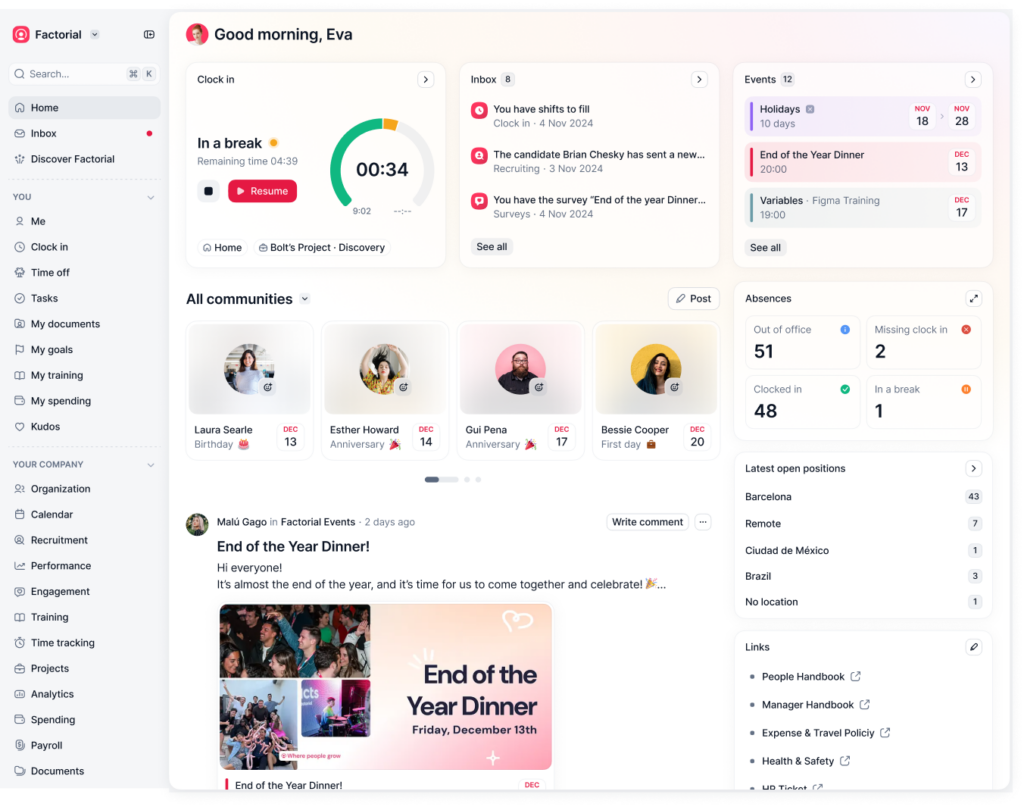
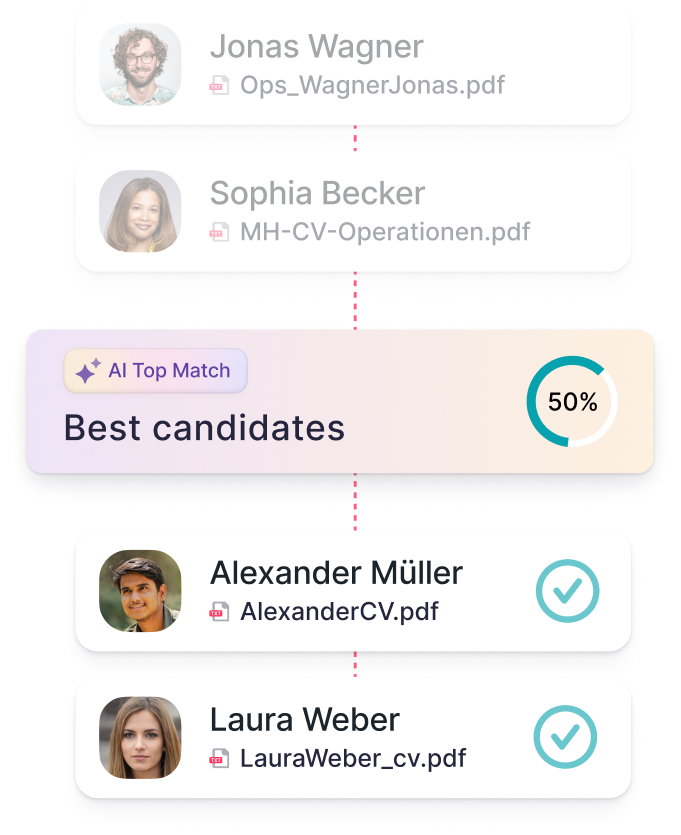
Factorial is a business management platform with an Applicant Tracking System module and candidate management system designed to streamline your hiring process. It offers features such as centralized candidate management, resume parsing, collaborative hiring workflows, and seamless communication with candidates. Factorial also provides additional HR tools, making it a comprehensive solution for managing the entire employee lifecycle.
Additionally, Factorial has built-in AI features that streamline the recruitment process. With its user-friendly interface and customizable options, Factorial is an excellent choice for businesses looking for an efficient and all-in-one ATS solution. Its key advantage is the integration of recruitment with core HR functions like payroll and time management, creating a single source of truth for the entire employee lifecycle.
Pros & Cons
Pros
✅ Ease of use
✅ Payroll integration (and more)
✅ More than just an ATS – comprehensive HR and business management toolkit
✅ Free demo
Cons
❌ No desktop app – only offers a mobile app and browser-based ATS platform
Also, if you want a short introduction to the other features Factorial offers, we recommend this video:
Factorial ATS features
Factorial offers a range of powerful features to enhance your hiring process and optimize your recruitment efforts. Here are some key features provided by Factorial’s Applicant Tracking System (ATS):
Company Page
Create a dedicated company page to showcase your organization’s history, values, and open positions. This page serves as an essential element of your online presence, allowing potential candidates to learn more about your company and culture.
Factorial also allows people interested in working for your company to apply without the need to create open positions.
Embedded Job Openings
Easily embed your list of open positions on your company website, ensuring that interested candidates can view and apply for available roles directly from your site.
Hiring Phases
Factorial guides you through the various stages of the hiring process. From screening to offer, you can seamlessly manage each phase. Appoint a dedicated hiring manager to oversee the process, ensuring a smooth and efficient experience for both recruiters and candidates. Follow candidates through the entire phase and see notes from each in one place.
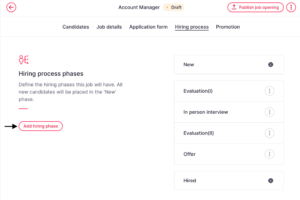
Without software to help structure the process, the recruitment process can quickly become confusing. Keeping track of all of the candidates and remembering to update all of them can turn searching for the best candidate to fill the open position into a nightmare for all of those involved.

Screening
Efficiently review resumes and applications to identify candidates who meet the basic qualifications for the position. Evaluate factors such as education, work experience, and specific skills to narrow down the applicant pool.
Interviews
Conduct comprehensive interviews with shortlisted candidates to assess their qualifications, experience, and cultural fit. Factorial supports integrations to allow different interview formats, including in-person, phone, and video interviews.
Assessments
Depending on the role, utilize assessments to measure candidates’ skills, knowledge, and aptitude. Factorial offers various assessment options, such as aptitude tests, personality assessments, and skills tests.
Job Offers
Once the ideal candidate is identified, extend a job offer, including essential details like salary, benefits, and start date. You can also include contingencies, such as background checks or drug screenings. Automatically send candidates an offer letter once they entire the corresponding phase in the hiring pipleline.
Onboarding
Streamline the onboarding process by inviting new employees to a restricted-access version of Factorial called Welcome Space. This allows them to complete tasks like uploading personal documents and providing necessary information before their first day.
Message Templates
Simplify communication with candidates using message templates. These templates ensure consistency, save time, and allow for customization with relevant details that can increase the likelihood of a successful hire.
Additional Features
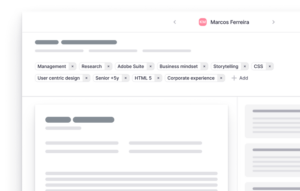
Factorial offers several additional ATS features, including an internal job openings page with referral capabilities, talent pool management, data retention options to comply with regulations like GDPR, automated data erasure for expired candidates, and a tag manager to easily filter and search for specific qualifications and experiences in the talent pool.
AI in the Recruitment Process
Factorial’s integration with AI has given recruiters even more freedom to spend their time with people instead of paperwork. AI helps hiring managers filter through resumes, analyze experience, and match skills to determine the best fit for a role. This helps recruiters make informed decisions and identify top candidates quickly. Factorial AI improves the objectivity and effectiveness of hiring, leading to better talent acquisition outcomes. AI lets you ask questions about hiring and get answers immediately.
For more information on AI recruiting software, read our article on the top AI tools for recruiting.
Pricing
Factorial starts at $8 for the core plan. Click the banner below to schedule a demo today for a personalized quote that is tailored to your needs for exact pricing.
2. Workday Recruiting
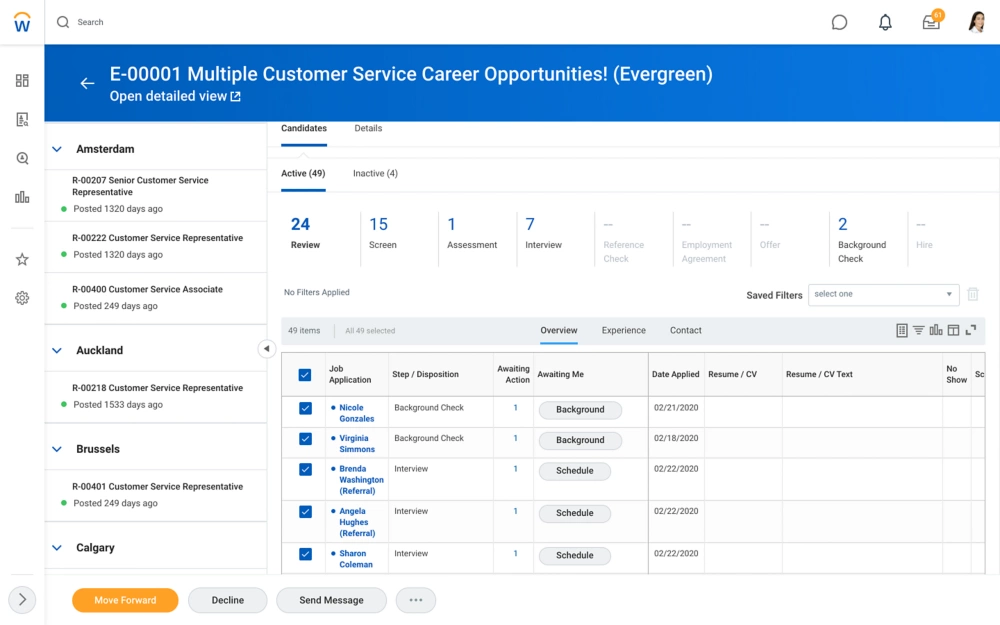
Workday Recruiting is a robust ATS known for its comprehensive features, including advanced candidate tracking, collaborative hiring workflows, and seamless integration with other HR systems. You can publish open positions to multiple job boards and automate the screening process. Additionally, Workday offers other HR tools; however, they come at an additional cost.
Pros & Cons
Pros
✅ Ease of use
✅ Adequate app integration
Cons
❌ No free trial
❌ Complicated application process from candidate side
3. Greenhouse
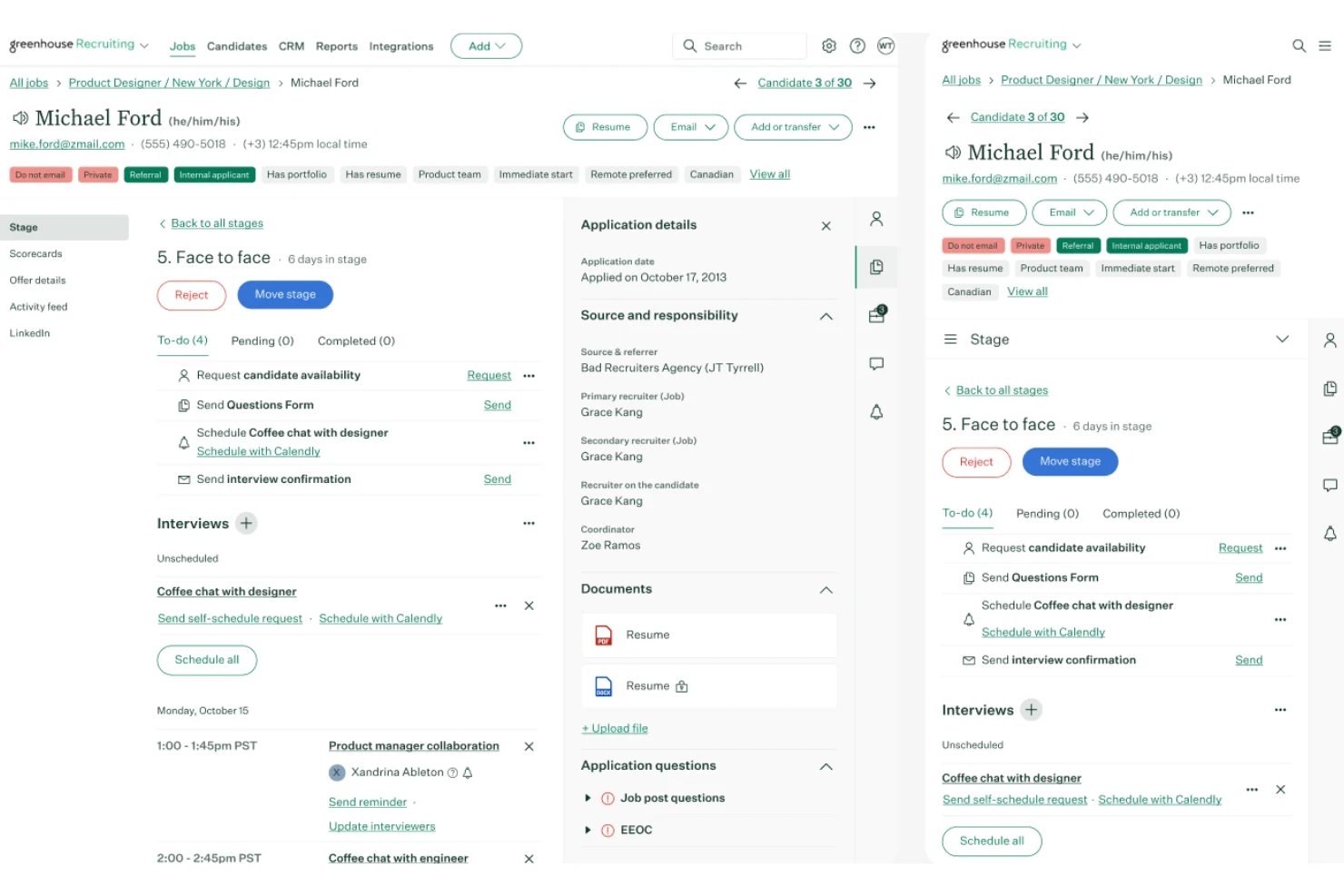
Greenhouse is a highly regarded cloud ATS that offers customizable hiring pipelines, intuitive interview scheduling, and insightful analytics to optimize your hiring process and make data-driven decisions. It’s packed with all the necessary ATS tools to make hiring decisions easier.
Pros & Cons
Pros
✅ Customizable
✅ Specifically for recruiting
Cons
❌ Candidate search in database needs improvement
❌ Complicated user interface
❌ No free trial
4. JazzHR
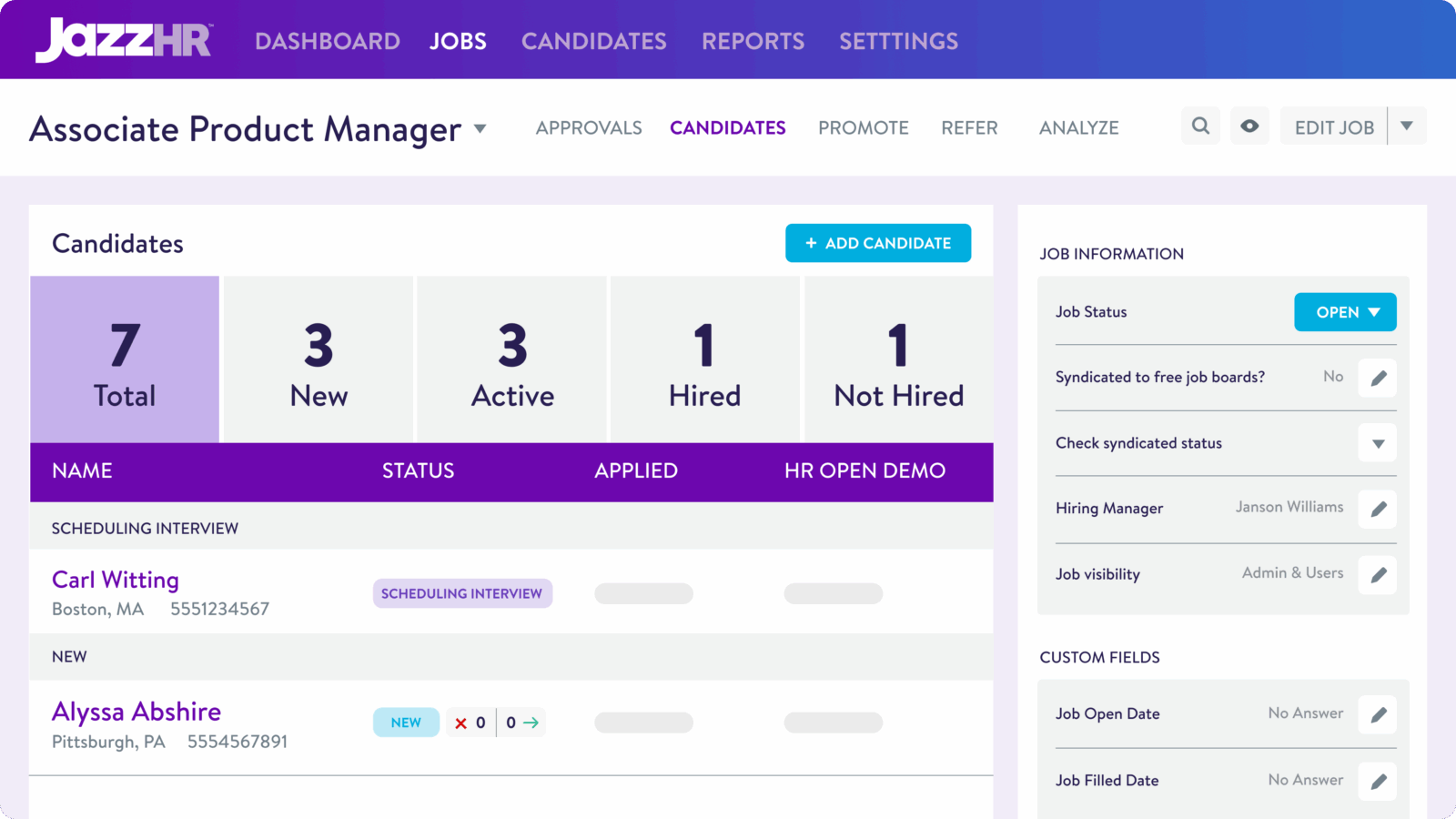
JazzHR is a cloud ATS system that is user-friendly and ideal for small and mid-sized businesses. It offers candidate tracking, resume parsing, and a wide range of integrations, all within an intuitive interface that simplifies hiring tasks. Additionally, JazzHR offers advanced features to support your recruitment team and create a more efficient recruitment process.
Pros & Cons
Pros
✅ Useful analytics
✅ Customer support
Cons
❌ Confusing automatic responses
❌ Complicated user interface
5. Lever
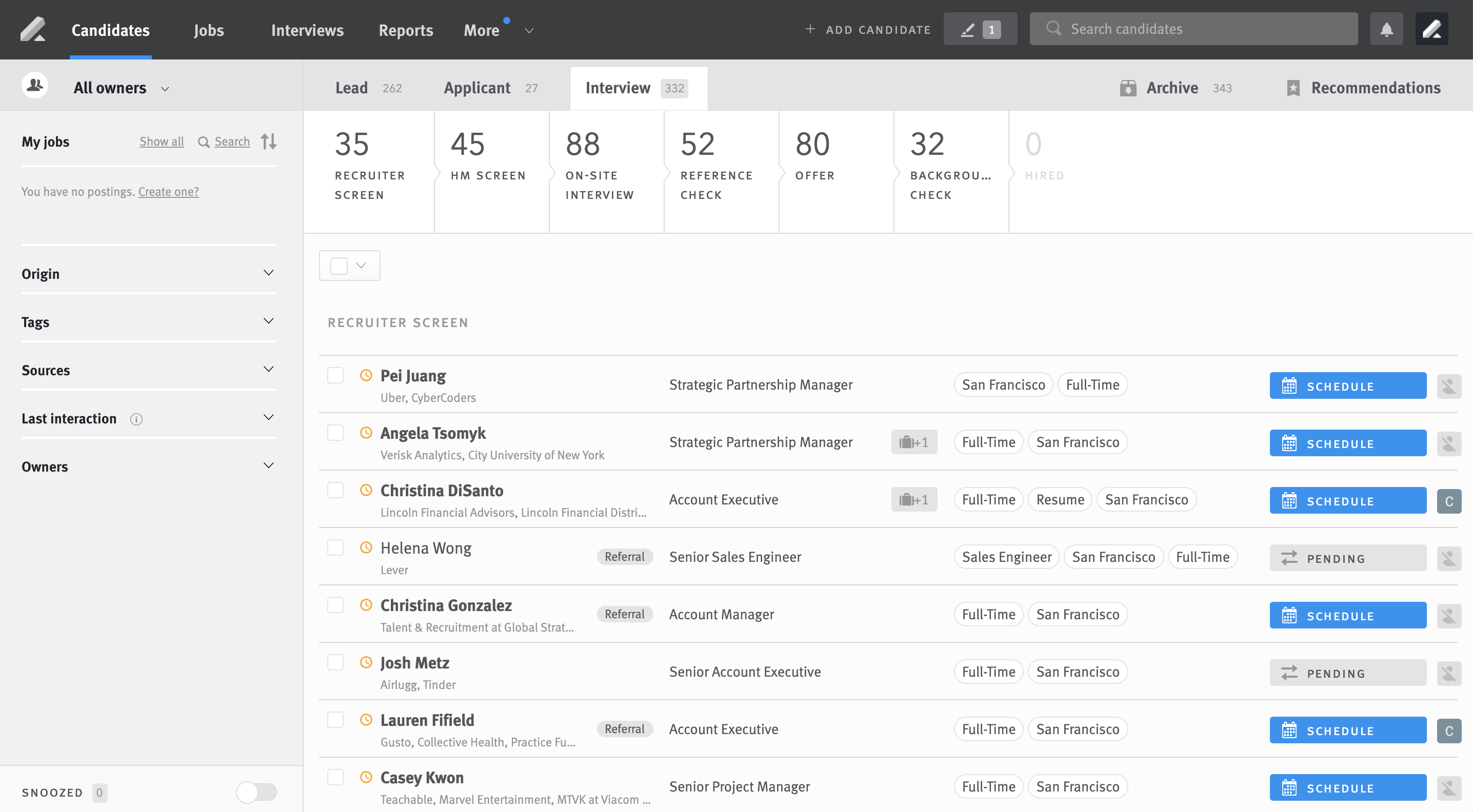
Lever is a modern Applicant Tracking System loved for its intuitive design and collaborative features. With Lever, you can streamline your hiring process, manage candidate pipelines effectively, and enhance team collaboration. Lever is a popular choice; however, it can be expensive for small businesses and is better suited for larger companies. With the right company size, it is one of the best applicant tracking system solutions for recruitment teams to ease their workload.
Pros & Cons
Pros
✅ Easy to use
Cons
❌ Poor design for candidate experience
❌ Formatting issues on the feedback form
6. Workable
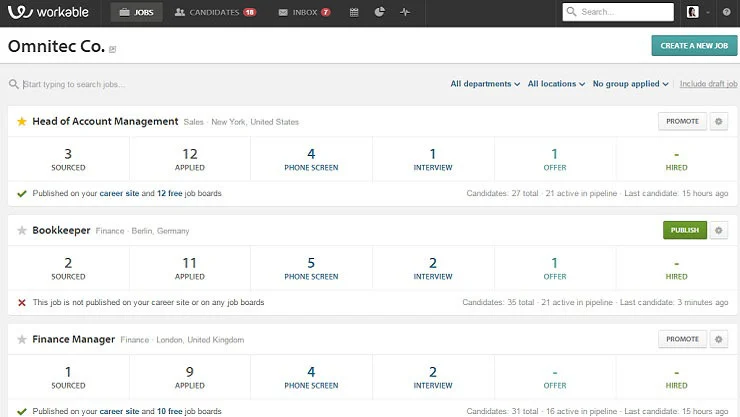
Workable is a popular ATS known for its user-friendly interface and comprehensive features. It offers job posting management, candidate tracking, collaborative hiring workflows, and integration with various HR tools. Workable streamlines the entire recruitment process, from sourcing candidates to making offers, making it an excellent choice for organizations of all sizes.
Pros & Cons
Pros
✅ Easy to navigate
✅ Templates
Cons
❌ Search functions need improvement
❌ Issues with the same candidate applying for different positions
7. iCIMS
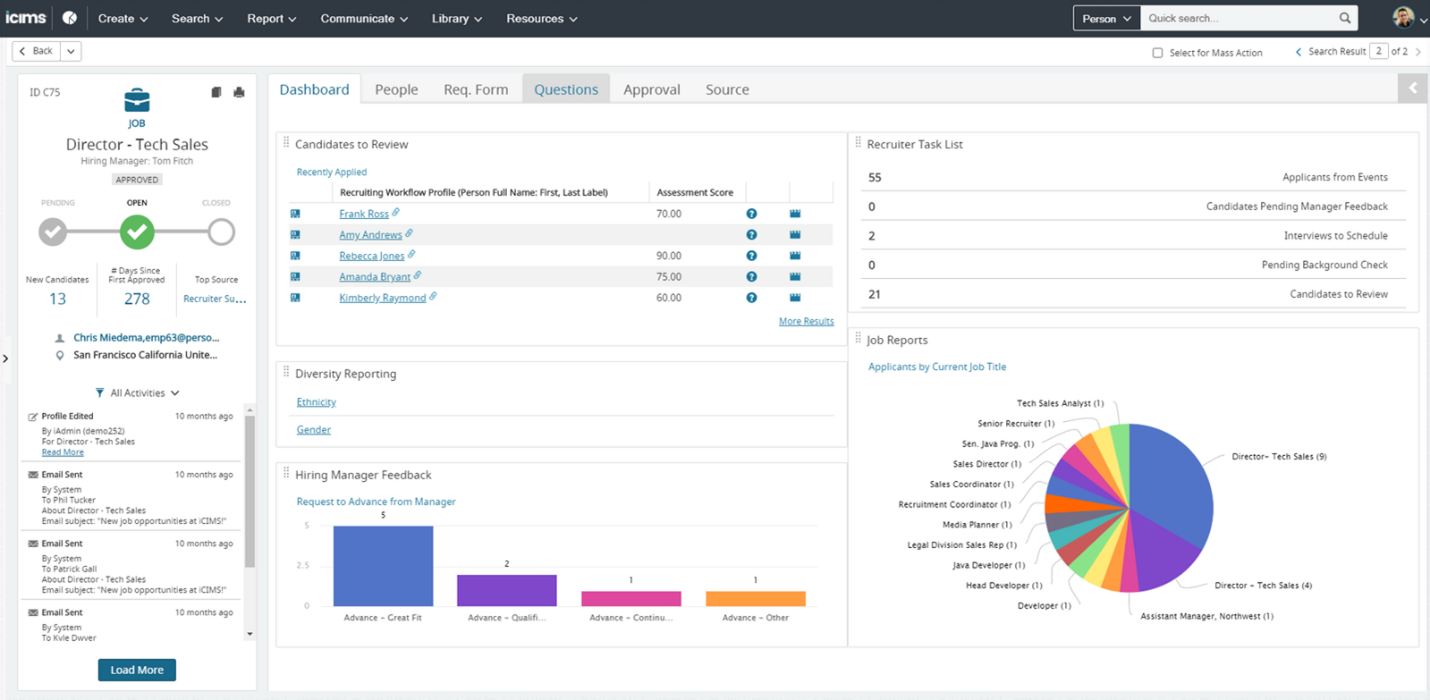
iCIMS is an enterprise-level ATS trusted by large organizations. It provides a comprehensive suite of ATS tools, including candidate sourcing, video interviewing, and robust reporting capabilities, ensuring efficient and scalable hiring processes.
Pros & Cons
Pros
✅ Customization
✅ Simple but functional layout
Cons
❌ Difficult to track internal hiring process
❌ Reports are limited
Benefits of Applicant Tracking Systems
Beyond simple organization, an ATS provides a significant return on investment (ROI) by optimizing key hiring metrics. In 2026, organizations that leverage ATS technology report tangible improvements in cost, speed, and quality of hire.
An ATS drives ROI across four primary areas:
- Cost savings: Calculate how much time, paper, or money is saved by automating manual tasks and reducing reliance on external recruiters.
- Time-to-hire: Measure how long it takes to fill a position before and after using an ATS. A shorter time-to-hire saves costs and improves productivity.
- Quality of hire: Assess the performance and retention rates of candidates hired through the ATS compared to previous hires. Better hires increase productivity and reduce turnover costs.
- Source effectiveness: Analyze ATS data to identify the most effective channels for finding qualified candidates. Allocate resources wisely by focusing on the channels that provide the best results.
An Applicant Tracking System can bring significant ROI, especially for organizations with high recruitment volumes or complex hiring processes. Evaluate your organization’s needs and choose an ATS that suits your requirements to maximize benefits and ROI.
To save even more money on the process of choosing the best applicant tracking system to suit your needs, take advantage of free demo calls! Get a free demo with an expert to answer all of your questions about Factorial and ATS in general. See for yourself why Factorial is the best applicant tracking system for your team.
Choosing the right ATS for your business
The best Applicant Tracking System is the one that aligns with your company’s size, hiring volume, and existing HR technology stack. For small to medium-sized businesses, an all-in-one platform like Factorial offers significant value by combining a powerful ATS with essential HR management tools, eliminating the need for multiple disjointed systems. This integration streamlines the entire journey from candidate to employee, ensuring data consistency and reducing administrative overhead. When making your decision, prioritize systems that offer a free trial or demo to ensure the user interface is intuitive for your team and that the feature set directly addresses your primary recruitment challenges.
The information presented on this page is based on publicly available sources, including but not limited to workday.com, jazzhr.com, icims.com, workable.com, Capterra public reviews, G2 public reviews, and Trustpilot public reviews. The comparisons between Factorial and other providers are intended solely for the illustration of the respective software features, pricing and functionalities. All information regarding features, prices, and integrations may be subject to change without prior notice. Factorial assumes no liability for the accuracy, completeness, or timeliness of the information presented. We recommend contacting the respective providers directly to obtain the most accurate and up-to-date information. All legal regulations regarding US fair advertising and competition law are fully observed by us; if you have any concerns, please reach out to us. The comparisons presented do not constitute a final evaluation or recommendation for any provider, but serve solely as an informational source.
Applicant Tracking System FAQs
The top Applicant Tracking System are platforms that are designed to make hiring easier by giving you tools to manage the entire hiring process including candidate pipelines and communication with applicants. Choosing the right one depends on your organization's size, hiring volume, and budget. Five good options for ATS are Greenhouse, Workday, iCIMS, Lever, and Factorial.
To pass an ATS, tailor your resume with keywords from the job description. Use a clean, simple format with standard fonts and clear section headings like "Work Experience" and "Skills." This helps the system parse your information correctly and match you with the role's qualifications.
The price of an Applicant Tracking System can vary quite a bit depending on how many users need access and what features are included. Some of ATS are free while others can cost several thousand dollars. Pricing models can also vary between providers. For some, you pay per recruiter, some per employee, and some have a fixed flat rate price per month or year.
To get a good Applicant Tracking System score, you can tailor your resume for each job. That means you should add keywords from the job description to your resume and use a clean, single-column Microsoft Word or PDF format and avoid tables, graphics, and text boxes, because these can confuse parsing software.
ATS relies on matching keywords. If it can't find the keywords from the job description in your CV, it may reject it. Also, make sure to provide your CV in the correct format, usually specified in the job description.