Choosing the best HR software is one of the most consequential decisions an HR team can make. Yet the market now holds thousands of options, making it genuinely difficult to separate high-impact tools from expensive noise. Different HR tools will benefit businesses in distinct ways. One non-negotiable tool is high-quality human resources management software (HRMS). HR management software efficiently handles employee data, optimizes HR workflows, maintains compliance with labor regulations, and boosts workforce productivity.
If you’re reading this, you’ve likely wondered how HR software can help solve your business needs or free up your time. Perhaps you thought HR software costs would be out of your budget. We’ll go over everything you need to know about HR systems to help you decide which one is the best HR software for you. By the end, you’ll have a list of the best software for HR options, helping you select the one that best fits your business’s specific needs.
Table of Contents
- Key Facts: Best HR Software in 2026
- What Is HR Software?
- What Does HR Software Do?
- What Are the Benefits of an HR Management System?
- What Should You Look for in an HR Management System?
- Top 12 HR Software
- How Is HR Software Changing in 2026?
- HR Software Comparison: Quick-Reference Table
Key Facts: Best HR Software in 2026
- Top pick: Factorial is the most complete all-in-one HR management platform for small and mid-sized businesses, covering time tracking, payroll, talent management, and analytics in a single system.
- Market size: The global HR software market is valued at $58.93 billion in 2026 and is projected to reach $78.44 billion by 2030, growing at a CAGR of 8.8%, according to The Business Research Company.
- AI adoption gap: SHRM’s 2026 “Navigating AI in the Workplace” report – which surveyed 5,875 U.S.-based workers – found that only 41% use AI for work purposes, yet AI integration is the top organizational priority for 40% of CEOs.
- Workforce technology demand: 7 out of 10 business leaders cite speed and agility as their primary competitive strategy. Integrated HR software is a strategic necessity, not just a back-office tool.
What Is HR Software?
HR software is a digital solution that enhances various HR management tasks within organizations, serving as a central platform for HR teams to manage personnel-related processes. Human resource systems, often referred to as HRIS (Human Resource Information Systems), are designed to offer essential analytics and insights for data-driven decision-making and can be customized to accommodate the specific needs of organizations of any size. In summary, HR software is a valuable digital tool for managing human capital, improving workforce efficiency, and maintaining HR best practices.
The scale of adoption reflects the business case. The Business Research Company’s 2026 HR Software Global Market Report values the sector at $58.93 billion this year, up from $54.19 billion in 2025. This 8.8% year-over-year increase is driven by the digitization of HR operations and the expansion of remote and hybrid work models. For U.S. businesses evaluating their options, that growth signals both the maturity of the category and the increasing sophistication of what these platforms can deliver.

What Does HR Software Do?
HR software serves as your digital, centralized hub for employee information, encompassing personal details, work history, contact information, and performance records.
One of its primary functions is to improve recruitment processes through features such as automated job postings, applicant tracking, resume parsing, and candidate assessment. These features allow HR teams to efficiently identify and onboard top talent. Additionally, it facilitates monitoring of employee attendance, tracking of working hours, management of leave requests, and processing of payroll.
Beyond these functions, this software supports performance management by facilitating goal setting, conducting regular evaluations, and tracking employee progress. It also enables the deployment of employee training and development programs, allowing organizations to create and manage training initiatives, including online courses, certifications, and skill enhancement efforts.
Furthermore, analytics and reporting tools are available to monitor workforce trends, identify areas for improvement, and measure or enhance team engagement through surveys, feedback mechanisms like 360-degree feedback, and performance analytics. Essentially, HR software covers virtually every HR role or task imaginable.
The strategic importance of these capabilities is growing rapidly. AI integration is the top organizational priority for 40% of CEOs, yet fewer than half of organizations that have adopted AI (47%) have formal policies governing its use. Modern HR software platforms are increasingly the infrastructure through which those policies are built and enforced.
What Are the Benefits of an HR Management System?
An HR management system enhances an organization’s HR processes and capabilities. Some of the most immediate benefits you might notice when implementing such a tool are increased efficiency, automated workflows, and reduced administrative burdens.
Long-term, your team members may experience improved job satisfaction and engagement, as well as a greater sense of transparency and fairness. On an organizational level, this can positively impact overall employee retention and talent acquisition. Some benefits from using HR software include:
- Increased Productivity: Eliminate manual tasks and paperwork, allowing more time and effort to focus elsewhere.
- Document Management: Centralize employee data, certificates, and records, minimizing errors and improving accuracy.
- Talent Management: Improve talent acquisition, onboarding, and retention.
- Performance Reviews: Simplify 360-degree employee reviews and gain insight into strengths and weaknesses.
- Generates Reports: Compile data using HR reporting software, highlight important analytics, and provide operational insights.
The business case for investing in HR technology is also supported by broader workforce research. Deloitte’s 2026 Global Human Capital Trends report – which surveyed more than 9,000 business and HR leaders across 89 countries in collaboration with Oxford Economics – found that 7 out of 10 business leaders identify speed and agility as their primary competitive strategy over the next three years. HR management systems that unify data, automate workflows, and surface real-time analytics directly enable that agility.
What Should You Look for in an HR Management System?
While HR management software can offer various functionalities, it’s important to assess how it contributes to time savings and the impact on your team. If the software you’re considering doesn’t include one of these core elements, consider it a red flag:
- Recruitment and Applicant Tracking: Post job openings, manage applications, and facilitate candidate communication.
- Time and Attendance Tracking: Log hours, process time-off requests, and approve time entries.
- Performance Management: Manage 360-degree feedback, performance appraisals, and track progress.
- Payroll Management: Calculate salaries, deductions, and taxes.
- Benefits Administration: Simplify management of health insurance, retirement plans, and leave policies.
- Training and Development: Create and manage employee training programs.
- Employee Self-Service: Enable employees to update their data, access pay stubs, and manage personal information.
How to Choose the Right HR Software for Your Business Size
The right HR platform depends heavily on your organization’s headcount, growth trajectory, and the specific HR problems you need to solve first. Use this framework before requesting demos:
- 1–50 employees: Prioritize ease of setup, transparent pricing, and core payroll and time-off management. Avoid enterprise platforms with lengthy implementation cycles.
- 51–500 employees: Look for a platform that covers the full employee lifecycle – from applicant tracking through offboarding – with strong reporting, integration capabilities, and employee self-service. Factor in workforce analytics and the ability to expand features over time.
- 500+ employees: Compliance depth, role-based access controls, advanced analytics, payroll compliance, and multi-state or multi-country payroll support become non-negotiable. Expect custom pricing and longer implementation timelines.
- Distributed or remote teams: Prioritize cloud-native platforms with mobile apps, multi-timezone support, and digital document signing.
Top 12 HR Software
The 12 platforms below were evaluated across six criteria: core HR feature depth, payroll and compliance capabilities, ease of use, integration options, pricing transparency, and user satisfaction scores from verified review platforms. Factorial leads the ranking as the most complete solution for small and mid-sized businesses.
1. Factorial: All-in-One HR Management
Factorial is a comprehensive HR management solution that encompasses toolsets for every HR function. This all-inclusive software is designed to improve HR operations, making it essential for HR teams. It is suitable for businesses ranging from small to medium-sized.
Overview
Factorial allows your HR team to easily manage time, talent, payroll, finance, key performance indicators (KPIs), employee self-service, and more. This HR management system is designed for various industries. Additionally, it enables you to integrate data with other digital solutions for simplified processes, whether it’s payroll, shift management, or data handling. Here’s a rundown of some of the core features of Factorial.
Time Management
Factorial enables you to handle time tracking, shifts, and time-off requests all in one place, eliminating the need for manual spreadsheets. Shift management facilitates easy organization of your team’s schedules. The absence and time-off management feature allows fast approval or rejection of requests.
Talent Management
Factorial’s talent management features let you track employee performance, build and plan your talent acquisition strategy, manage onboarding and offboarding, and track your HR goals.
Payroll and Finance
With its automated employee payroll management system, you gain a clear overview of payroll calculations, payslip creation, supplement review, and smooth payroll communication. Access is also provided to certified bookkeepers for handling complex scenarios.
App Integration
Factorial integrates with 5,000 apps such as Google Workspace, Sage, and Indeed. Build custom integrations using Factorial’s API for greater flexibility. Factorial’s app marketplace enables integration partners to reach more customers.
HR Reports & KPIs
Factorial’s HR reporting functionality helps generate personalized workforce analytics using account data, offering visualization formats and the ability to share and download reports. Factorial also covers survey data and performance evaluations.
Pros
✅Integration with over 5,000 apps
✅Comprehensive HR modules
✅Full employee empowerment and self-service
✅A clear view of financial resources
✅Real-time spend analysis and workforce analytics
✅Automation and reporting
✅Free demo consultation
Cons
❌No downloadable software for PCs – use the web-based version and mobile application
User Satisfaction and Reviews
Factorial receives high marks from users for being user-friendly and customizable, with wide-ranging functionalities. It’s a top choice for an all-in-one, centralized HR hub.
Pricing
Prices vary by customizable bundle. Find them all here.
Best For
Small to mid-sized businesses (1–500 employees) seeking a single platform that covers time tracking, payroll, talent management, and HR analytics without requiring multiple vendor contracts.

2. Sage
Sage HR is a comprehensive HR management software with numerous features. As a customizable option, Sage HR helps organizations manage their workforce efficiently.
Overview
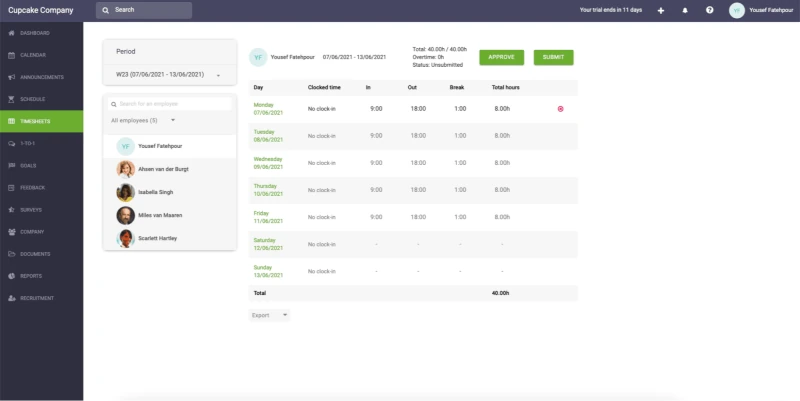
Sage provides a complete employee management system for any HR team. Its user-friendly dashboard is the hub for personalized functions, showing key data at a glance, from time-off requests to attendance records. It also aids in benefit administration and lets managers review salary details for budgeting.
Sage offers overtime calculations that sync with payroll. Configurable communication hubs help share vital news. Employees can upload documents like medical bills for benefit checks, and HR can track progress and assign training plans.
Pros
✅Good integration options
✅Intuitive platform
✅Strong customer support
Cons
❌The recruitment module is expensive, quoted at $200 PEPM
❌An admin must enable employees to clock in/out via the app
User Satisfaction and Reviews
Sage stands out for its versatile pricing, intuitive interface, and strong Outlook integration. Its holiday entitlement management increases transparency for HR professionals and employees.
Pricing
Pricing starts at $6 PEPM for the basic plan and additional add-ons range from $1.50-$200 PEPM.
Best For
Small to mid-sized businesses already using Sage accounting software that want a tightly integrated HR and payroll solution with strong Outlook compatibility.
3. BambooHR
BambooHR is a versatile HR solution ideal for managing multiple HR functions, especially for small to medium-sized businesses.
Overview
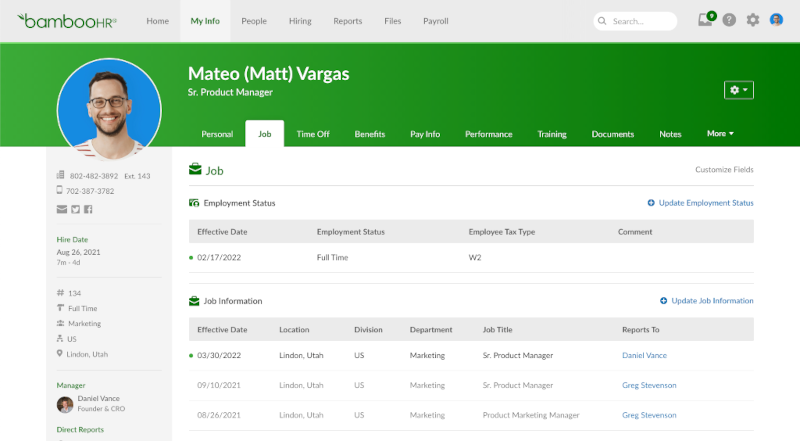
Designed for small and mid-sized businesses, BambooHR offers an intuitive platform for HR tasks and policy editing with secure access settings. Workflow triggers are customizable, and all changes are tracked with audit trails.
Pros
✅ Exceptional onboarding and offboarding
✅ Ideal for smaller businesses
✅ Integrates with third-party apps
✅ Strong reporting
Cons
❌ Missing feature notifications
❌ Several features require added-cost add-ons
User Satisfaction and Reviews
BambooHR simplifies applicant tracking, time management, and payroll processing for businesses of all sizes. Its interface is accessible for organizations with or without dedicated HR personnel.
Pricing
You must contact BambooHR directly for a quote.
4. Paylocity
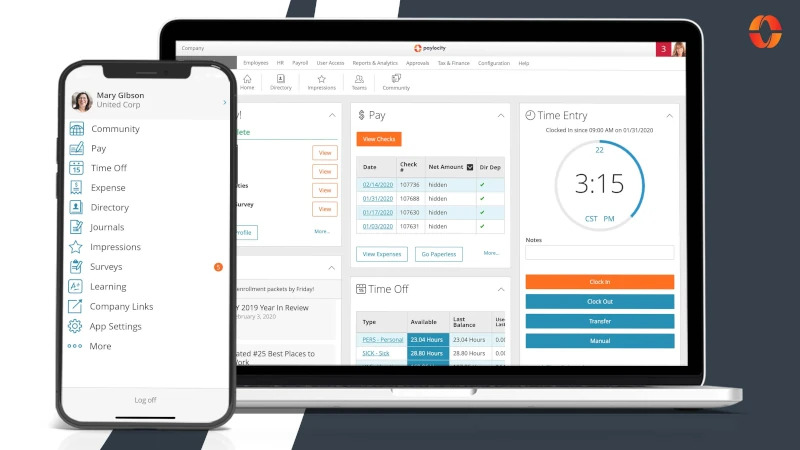
Paylocity assists businesses of all sizes with employee administration tasks.
Overview
Paylocity is known for payroll but also offers talent acquisition, time tracking, benefits administration, and workforce management (WFM). It features a dashboard for workflow visibility and reminders for coworkers. The information hub covers topics from healthcare to salary benchmarking.
Pros
✅ Personalized assistance
✅ User-friendly interface
✅ Self-service features
Cons
❌ Not the most cost-effective
❌ Not the most comprehensive solution
User Satisfaction and Reviews
Paylocity simplifies administration and offers detailed reporting for compliance. The user interface and self-service capabilities provide value for decision-making.
Pricing
Paylocity does not publish pricing publicly. Based on third-party market data, the platform typically costs $22–$32 per employee per month (PEPM) for the full HCM suite, depending on modules selected and company size. Contact Paylocity directly at paylocity.com/pricing for a custom quote.
Best For
Mid-sized U.S. businesses (50–5,000 employees) that need a modern, cloud-based HCM platform with strong payroll processing and self-service tools, and are comfortable with custom-quote pricing.
5. ADP Workforce Now
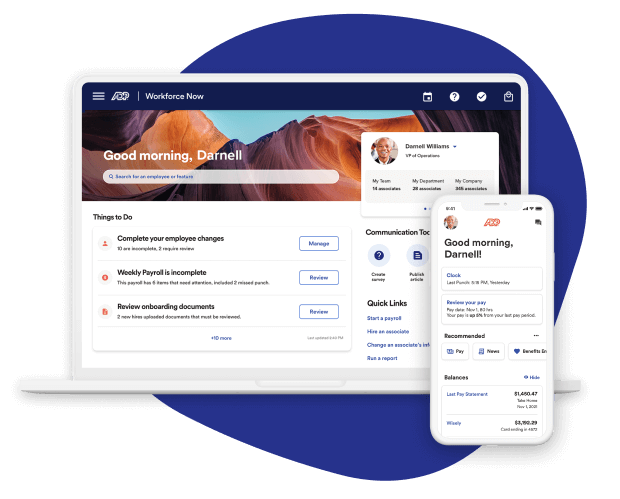
ADP Workforce Now is a reliable HR solution tailored to a wide spectrum of HR responsibilities.
Overview
ADP Workforce Now provides a digital management system with user-friendly HR features. Templates assist with onboarding and quick hiring via job board integrations. The platform includes self-service resources and built-in employee surveys, calculators, glossaries, and tax guides.
Pros
✅ Strong compliance and reporting
✅ Strong integration and automation
✅ Excellent payroll features
✅ Useful resources
Cons
❌ Higher cost
❌ Interface could be more user-friendly
User Satisfaction and Reviews
While ADP Workforce Now may not excel in every individual module, its comprehensive package is attractive. Consolidating a range of functions, including time and attendance, payroll, performance reviews, and central contact info, is highly valued by users.
Pricing
ADP Workforce Now does not publish pricing on its website. Third-party market data consistently places platform fees at $23–$30 per employee per month (PEPM) for most mid-market organizations (50–1,000 employees), rising to $30–$50 PEPM when outsourced payroll or compliance services are bundled in. Contact ADP directly at for a custom quote.
Best For
Mid-sized to large U.S. businesses (50–1,000 employees) that prioritize payroll accuracy, tax compliance, and access to a broad ecosystem of HR add-on modules from a well-established provider.
6. Workday HCM
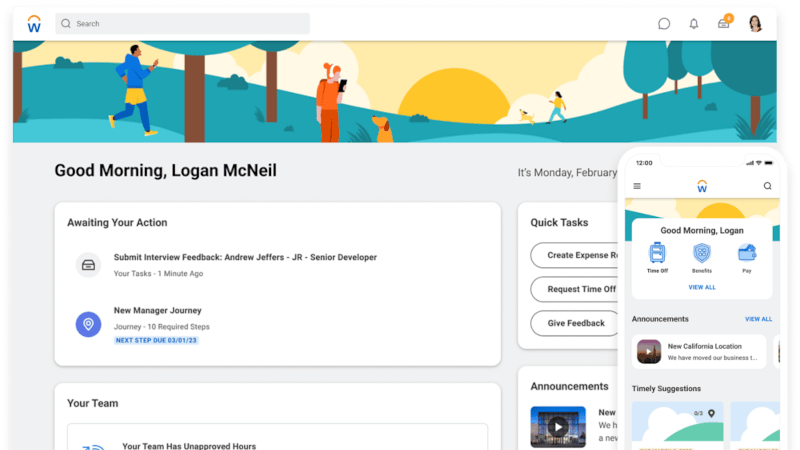
Workday HCM offers comprehensive HR and talent management capabilities for organizations to improve engagement and workforce management.
Overview
Workday HCM supports recruitment, onboarding, performance management, compensation planning, talent development, and succession planning on a unified platform. Data is integrated across HR processes.
Pros
✅ Many features
✅ Excellent search and navigation
✅ Accessible for new users
Cons
❌ Workflow integration can be challenging for global changes
❌ Premium pricing
User Satisfaction and Reviews
Users value Workday’s UI, ease of navigation, and comprehensive personnel reporting, especially for HRIS professionals.
Pricing
While pricing details require a quote request, some users have reported an average of $99 PEPM.
Best For
Large enterprises (1,000+ employees) with complex global workforce structures that require a unified platform for HR, finance, and planning, and have the budget and IT resources for a full enterprise deployment.
7. UKG Pro
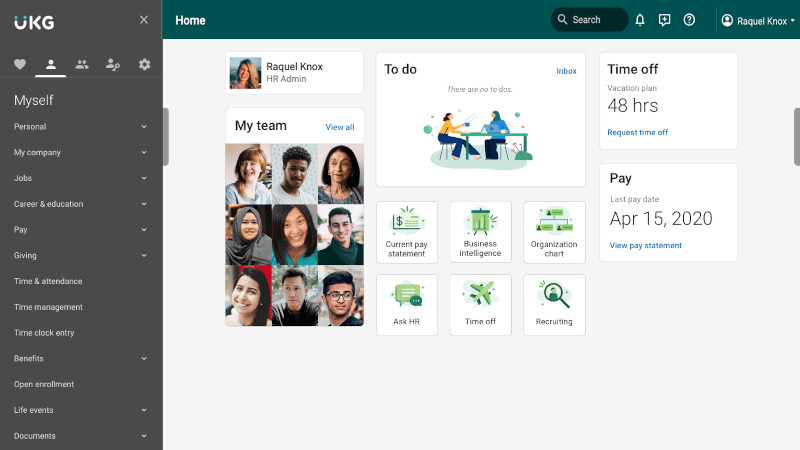
UKG Pro is tailored for organizations that prioritize workforce diversity and company culture, with a focus on the employee experience. Designed for small to medium-sized businesses, UKG Pro provides wide-ranging HR tools.
Overview
UKG Pro is a comprehensive HR system encompassing payroll, talent management, learning, onboarding, workforce management (WFM), and workforce planning. It is well-suited for medium to large companies, addressing recruitment, onboarding, employee engagement, and continuous training.
Pros
✅ Customizable setup
✅ Automated reporting
✅ Sandbox option for newcomers
Cons
❌ Limited configuration for candidate experience
❌ Calendar lacks PTO management features
User Satisfaction and Reviews
Users appreciate the friendly interface, customization options, and training module support in UKG Pro.
Pricing
Best For
Medium to large organizations (200+ employees) that prioritize workforce diversity, employee experience, and a highly customizable HR platform with strong learning and development modules.
8. Oracle Cloud HCM
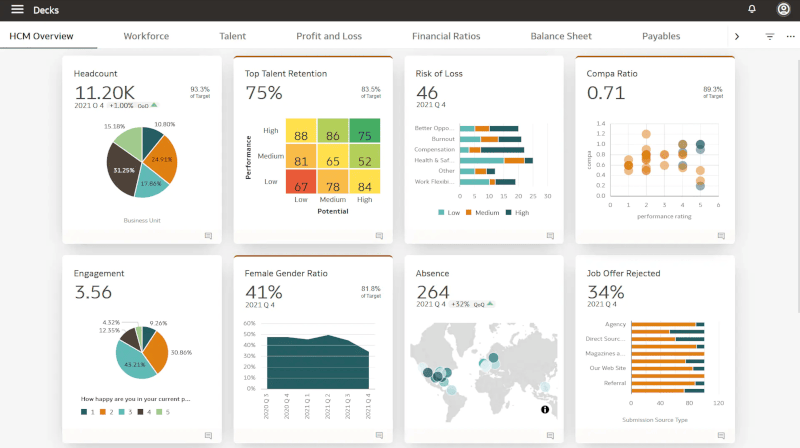
Oracle Cloud HCM is a comprehensive HR software for companies at every workforce management stage, featuring various integrated modules.
Overview
Oracle Cloud HCM unifies HR processes and stakeholders within a single experience, creating a single, reliable HR data source for informed decisions. Modules include benefits administration, payroll processing, and performance and talent management.
Pros
✅ User-friendly interface
✅ Configurable for different needs
Cons
❌ Primarily suited for companies with 1,000+ employees
❌ Some self-service functions are unintuitive
❌ Users report update-related reporting issues
User Satisfaction and Reviews
Reviewers highlight flexibility, configurability, and strong reporting tools. The comprehensive coverage from hire to retire is valuable for enterprise clients.
Pricing
Contact Oracle Cloud HCM directly for a quote.
Best For
Large enterprises (1,000+ employees) that need a deeply configurable, unified HCM platform with strong benefits administration and a single source of truth for HR data across the full employment lifecycle.
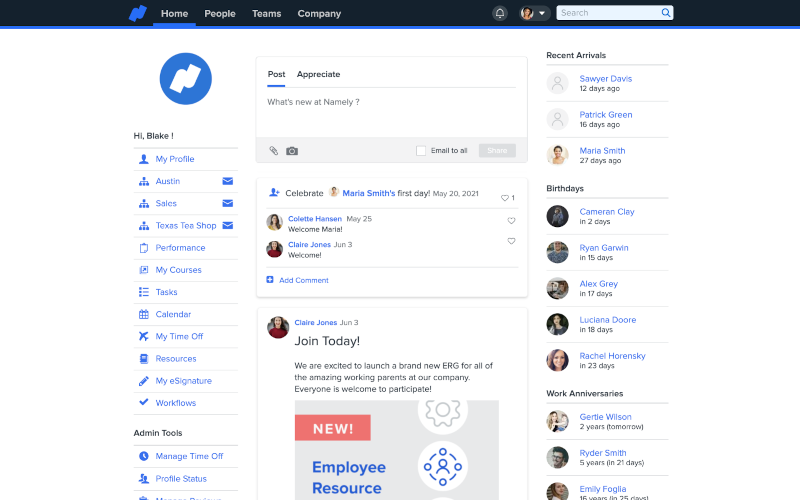
9. Namely
Namely delivers a management system with diverse features to assist business HR teams in managing workforces, enhancing engagement, and driving growth through data.
Namely Overview
For mid-sized businesses (25 to 1,000 employees), Namely provides an all-in-one HR solution with a simple, cloud-based experience. The platform covers HR, payroll, benefits, talent management, and analytics.
Pros
✅ Simple layout and intuitive interface
✅ Employee event timeline with comment and like features
Cons
❌ Lacks compensation planning functionality
❌ Workflow setup can be difficult
❌ Customer support can improve
User Satisfaction and Reviews
Namely is popular for remote HR management, information synchronization, integration, and onboarding support. Educational resources for HR and employees are also a benefit.
Pricing
Starts at $9 PEPM for the basic package. To learn more about their prices, you must contact them directly.
Best For
Mid-sized U.S. businesses (25–1,000 employees) that want an all-in-one HR, payroll, and benefits platform with a social-media-style employee experience layer and cloud-based accessibility.
10. BreatheHR
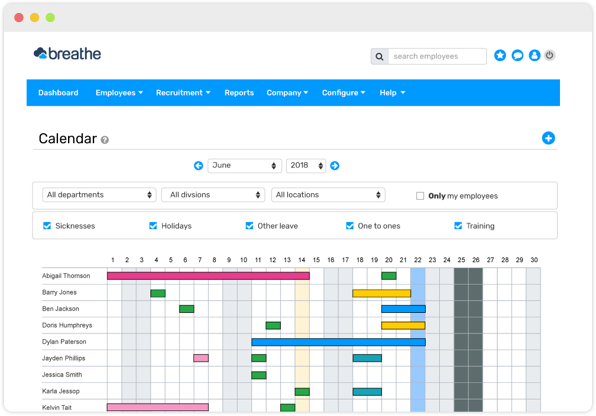
BreatheHR offers features for small and medium-sized businesses to manage employee data, time off, and performance.
Overview
BreatheHR is a secure employee database, supporting custom data fields, intuitive calendars for time-off management, and performance management tools for regular reviews and feedback.
Pros
✅ Effective time-off management
✅ Comprehensive performance management module
Cons
❌ Feature limitations
❌ Limited scalability
User Satisfaction and Reviews
Praised for its user interface and customer support, BreatheHR is ideal for efficiency, though some users want more customization and better reporting.
Pricing
BreatheHR pricing is denominated in GBP and is primarily designed for the UK market. Pricing starts at £13 per month for up to 10 employees, with a tiered model reaching £500 per month for up to 200 employees. U.S.-based businesses should confirm current USD pricing and feature availability directly at breathehr.com/pricing.
Best For
Small to mid-sized businesses (under 200 employees) – primarily in the UK market – that need a straightforward employee database with solid time-off management and performance tracking at a predictable monthly cost.
11. CIPHR
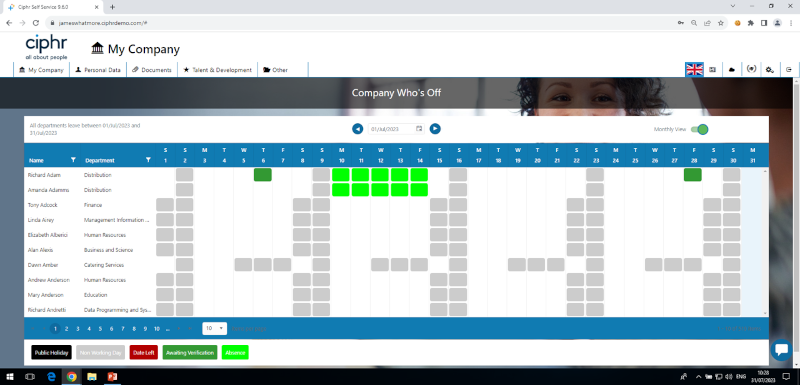
CIPHR is an emerging HR tool with an array of features for HR teams.
Overview
CIPHR delivers a comprehensive HR management system, providing recruitment, onboarding, performance management, absence management, employee self-service, and reporting features.
Pros
✅ Customizable and scalable
✅ Wide feature set
Cons
❌ Some complexity
❌ Pricing
User Satisfaction and Reviews
User satisfaction varies. Many appreciate customization, feature range, and report generation, while others find the system complex or challenging to implement and integrate.
Pricing
For pricing, contact the CIPHR team for a personalized quote.
Best For
Mid-sized to large UK and European organizations that need a highly customizable, scalable HR platform with strong recruitment, onboarding, and absence management modules and have the internal resources to manage a complex implementation.
12. HiBob
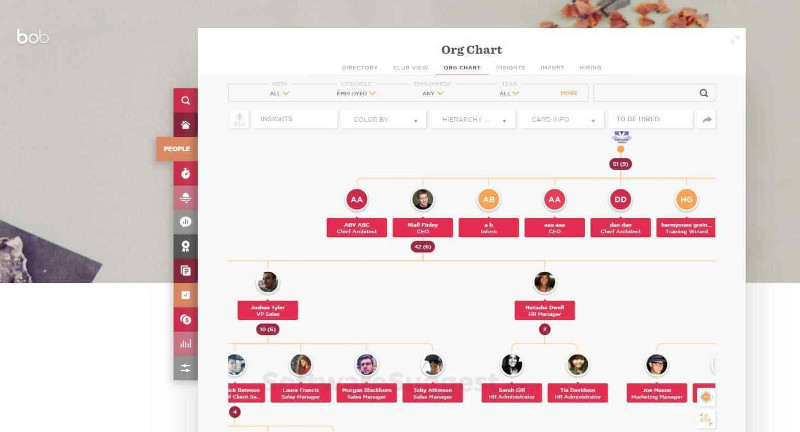
HiBob is designed for midsize enterprises, offering a range of HR modules to support teams in their daily work.
Overview
HiBob delivers an intuitive, data-driven HRIS platform for global, remote, and collaborative teams. Its HR modules cover onboarding, workflows, payroll, and performance management, and include a downloadable HR app.
Pros
✅ Employee self-service functionality
✅ Integration capabilities
Cons
❌ Lacks pricing transparency
❌ Learning curve for adoption
User Satisfaction and Reviews
HiBob gets positive reviews for comprehensive HRIS features, although opinions on ease of use are mixed.
Pricing
For pricing information tailored to your company’s needs, contact HiBob to receive a personalized quote.
Best For
Mid-sized and multinational companies (100–2,000 employees) with global, remote, or hybrid teams that need an agile, data-driven HRIS with strong workflow automation and a modern employee experience layer.
How Is HR Software Changing in 2026?
The HR software landscape is undergoing its most significant transformation in a decade, driven by three converging forces: AI integration, workforce fragmentation, and rising compliance complexity.
As previously mentioned, 41% of employees now use AI for work purposes, yet fewer than half of organizations that have adopted AI (47%) have formal policies governing its use. HR software platforms are increasingly the infrastructure through which those governance frameworks are built, monitored, and enforced.
The ability to adapt continuously and move with speed may be the defining competitive advantage of the next three years. Platforms that unify HR data, automate routine workflows, and surface predictive workforce analytics – rather than simply digitizing paper processes – are the ones best positioned to deliver that advantage.
For HR teams evaluating software in 2026, the practical implication is clear. Prioritize platforms with native AI features, open API ecosystems, and real-time reporting over legacy systems that require manual data exports and spreadsheet analysis.
HR Software Comparison: Quick-Reference Table
| Platform | Best For | Starting Price (USD) | ||
|---|---|---|---|---|
| Factorial | SMBs (1–500 employees) | Custom from $8 | ||
| Sage HR | SMBs using Sage accounting | From $6 PEPM | ||
| BambooHR | Small to mid-sized businesses | Custom quote | ||
| Paylocity | Mid-market (50–5,000 employees) | ~$22–$32 PEPM | ||
| ADP Workforce Now | Mid-market to enterprise | ~$23–$30 PEPM | ||
| Workday HCM | Large enterprises (1,000+) | ~$99 PEPM (reported) | ||
| UKG Pro | Medium to large organizations | Custom quote | ||
| Oracle Cloud HCM | Large enterprises (1,000+) | Custom quote | ||
| Namely | Mid-sized U.S. businesses | From $9 PEPM | ||
| BreatheHR | Small businesses (UK-focused) | From £13/month | ||
| CIPHR | Mid-large UK/EU organizations | Custom quote | ||
| HiBob | Mid-sized global/remote teams | Custom quote |
FAQ
What software do HR professionals use?
HR professionals use software to simplify core functions like recruitment, time and attendance tracking, performance management, and payroll. An integrated system centralizes employee data, automates workflows, and provides analytics to support data-driven decisions and ensure compliance.
Which HR system is best?
The best system centralizes all HR functions into a single, easy-to-use platform. Factorial, an all-in-one business management software, is a top choice for its comprehensive features that cover time, talent, and payroll management, making it highly adaptable for businesses of any size.
What is the best HR and payroll software?
The best software smoothly integrates HR functions with payroll to ensure accuracy and efficiency. Factorial, an all-in-one business management software, offers automated payroll that syncs with time tracking and other HR data, simplifying the entire process from payslip creation to compliance.
What are the top 10 HR management software?
Top-rated HR management software provides comprehensive modules for recruitment, onboarding, time tracking, performance management, and payroll. The leading options offer a centralized platform with robust reporting, employee self-service capabilities, and extensive integration options to simplify all HR processes.
The information presented on this page is based on publicly available sources, but not limited to,,,, Capterra public reviews, G2 public reviews, and Trustpilot public reviews. The comparisons between Factorial and other providers are intended solely for the illustration of the respective software features, pricing, and functionalities. All information regarding features, prices, and integrations may be subject to change without prior notice. Factorial assumes no liability for the accuracy, completeness, or timeliness of the information presented. We recommend contacting the respective providers directly to obtain the most accurate and up-to-date information. All applicable advertising and competition law regulations are fully observed by us. If you have any concerns, please reach out to us. The comparisons presented do not constitute a final evaluation or recommendation for any provider, but serve solely as an informational source.