The performance management cycle: A guide to boosting growth across your organization
Let's be honest: performance management in many organizations is fundamentally flawed. Currently, 64% of workers see annual reviews as a waste of time. And only 2% of CHROs believe their performance systems actually work. As a whole, 72% of workers don't trust the process.
Here’s a simple truth: Every organization needs their people to care and needs them to perform at their best. Performance management can be the tool that makes that happen. But it takes work.
We put together this guide to rethink and redefine modern performance management processes, moving away from outdated annual reviews to continuous processes that foster individual growth and create inspiring places for people to do their best work.
If you want to build a winning performance management cycle, this guide will help you get started today.
Some insightful data about the performance management cycle.
2%
of CHROs
believe their current performance management system works.
50%
of managers
found out too late that one of their team members was struggling.
72%
of workers
don't trust the performance management cycle.
How to rebuild the performance management cycle?
When it comes to the performance management cycle, few concepts matter as much as success. That’s because it is a complex subject: success looks different across every part of your business (this is especially true in high-performance cultures), and it obviously isn’t a siloed affair, but can become one if splitted around email chains and Excel files.
Departments should know how their success contributes to the entire organization, but without some kind of unified framework, you risk creating a culture of inconsistency. If you want to build a holistic performance cycle that supports your business goals, this guide is designed for you.
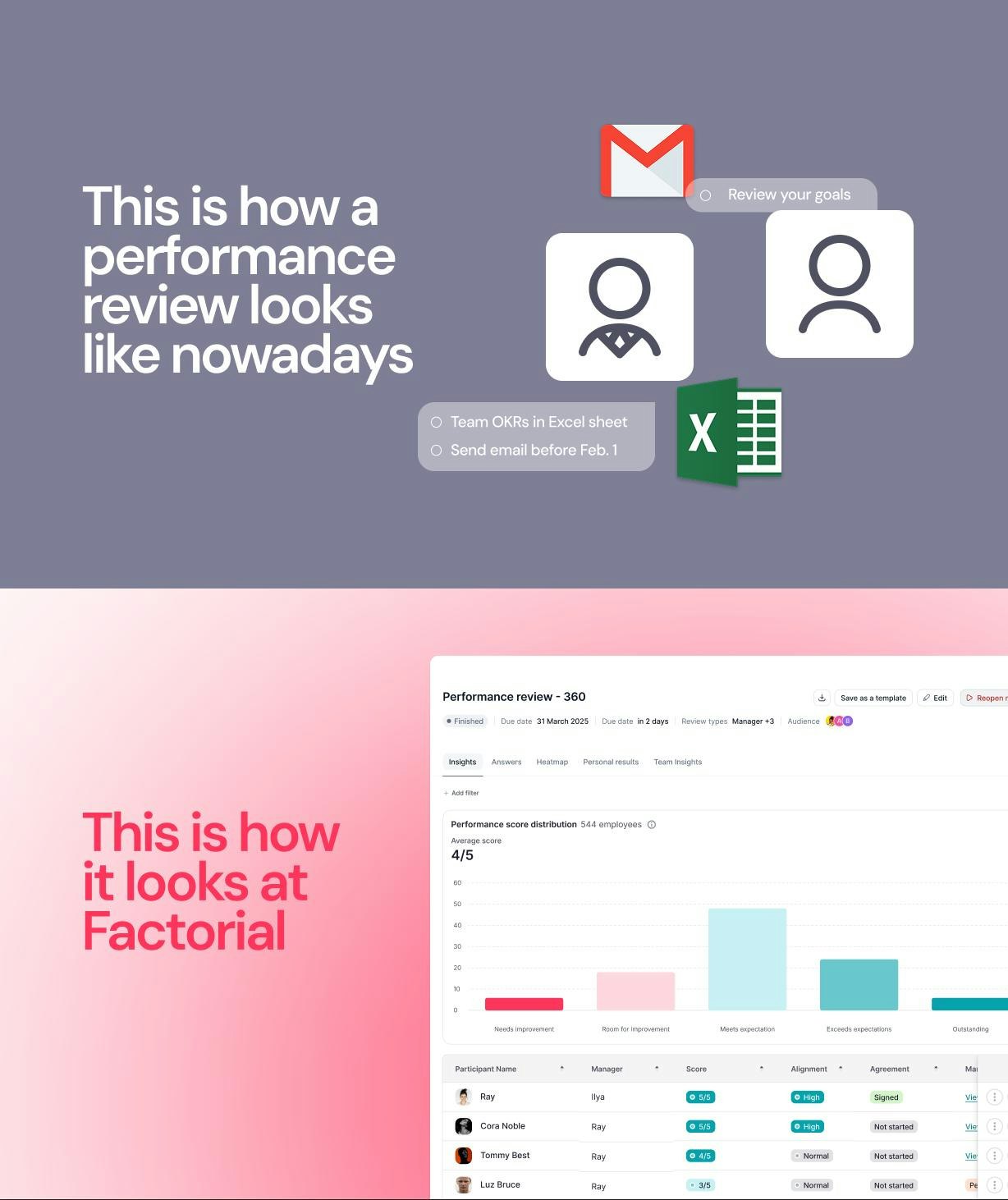
The performance management cycle, explained
- Phase one: Proper planning. From defining how does success look like, to cascading it down at your organisation tying a golden thread through success metrics.
- Phase two: Continuous development. Best practices straight out of our own real experience so you can focus on what actually matters: supporting and enabling managers at scale.
- Phase three: Running great performance reviews. Why only 2% of CHROs believe their current performance system actually works? To explain the reason behind that, we must take a look into what makes 72% of workers not trust the process: the lack of a holistic review that helps capture the whole performance.
- Phase four: Rewarding and retaining talent. The total rewards ecosystem validates the real human behind the performance, and this has a real impact on your culture. If you want to retain the people that matter the most to your organisation, make sure to recognise their talent in a proper way.
Useful resources for implementing a successful performance review cycle.
Some of our recommended resources than can help you nail the entire performance management process.
Blog posts
Frequently Asked Questions about the performance management cycle
Some legitimate questions on unlocking talent
What is the performance management cycle?
The performance management cycle is a continuous process of planning, developing, reviewing, and rewarding employees to maximise both individual and organisational value. It's not a once-a-year review, but an ongoing conversation that aligns individual work with the company goals.
Why do traditional performance reviews fail?
The traditional performance management cycle fails because it is too infrequent, too administrative, and too disconnected from daily work. When you wait a full year to address performance issues, you're opening the door to low engagement and attrition. According to Deloitte, 64% of workers see them as a waste of time because they've become checkbox exercises instead of meaningful conversations.
How often should we conduct performance reviews?
Instead of annual reviews, high-performing organizations use monthly or bi-weekly check-ins for ongoing feedback, with quarterly reviews for deeper developmental conversations. The key is frequency, because regular touchpoints allow you to course correct early and keep development conversations separate from compensation decisions.
What's the difference between results-oriented and behavioral approaches in the performance management cycle?
Results-oriented approaches work best for roles with clear, measurable outputs (like Sales hitting quotas). Behavioral approaches work best for roles where individual results are harder to isolate (like HR or Design), focusing on the quality of work and behaviors that drive long-term value. Both are valid, you just need to match the right approach to the right role.
How do we ensure fairness across different departments?
Create a unified framework where every goal connects back to your company's top 3-5 priorities. Use the "Golden Thread" approach to cascade goals from company level to department level to individual level. This ensures that "exceeds expectations" means the same level of effort and impact across all teams.
What topics should we cover in 1:1 meetings with our reportees?
1:1 conversations should focus on growth, not just status updates. Cover progress toward goals, resources needed, obstacles to remove, and developmental opportunities. These should be forward-looking conversations where managers act as coaches, not just supervisors checking off tasks.
Should we separate compensation and development conversations during the performance management cycle?
Yes. The human brain struggles to process developmental feedback when anxiously waiting to hear about pay. Separate these conversations, even by just a week, to lower defensive shields and create psychological safety for honest growth discussions.
How do we implement 360-degree feedback effectively?
Use structured prompts that demand evidence over opinion. Train employees to provide specific, behavioral feedback focused on actions rather than personality. Make sure you're capturing three dimensions: Task Performance (technical output), Contextual Performance (teamwork and collaboration), and Adaptive Performance (resilience in change). Use a tool like Factorial to gather feedback through different surveys to add another layer of feedback to your team's performance.
What if we don't have budget for big salary increases during the performance management cycle?
Focus on total rewards beyond the paycheck: public recognition, well-being programs, flexible work arrangements, learning opportunities, and celebrating small wins help create momentum. Transparency about how rewards are calculated also builds trust.
How can AI help with the performance management cycle?
AI can automate administrative tasks like scheduling reviews, tracking goal progress, and generating discussion prompts. This enables managers to focus on the human side of performance. According to our 2025 AI Report, 78.6% of European companies say AI has increased their productivity. The key is using AI to enable better conversations, not replace them.
What's a stretch goal in the performance management cycle and when should I use it?
Stretch goals push employees beyond their current capabilities to drive growth and innovation. They should be ambitious enough to inspire but realistic enough not to damage morale. Combine standard performance goals (what's expected) with stretch goals (what would be exceptional) to create a balanced growth framework.
What's the biggest mistake companies make with performance management?
Treating it as an annual administrative event instead of a continuous development process. When performance management becomes about filling out forms instead of having real conversations, both managers and employees disengage. Make it frequent, make it developmental, and make it human.
What platforms help managers give timely feedback?
Factorial makes continuous feedback effortless. Managers can give real-time recognition, log coaching conversations, and document developmental feedback throughout the whole year. This creates a running record of performance that makes annual reviews more accurate and less stressful for everyone involved.
How do I track employee goals and progress in one system?
Factorial gives you a single source of truth for all performance data. From company-wide goals down to individual tasks, you can visualize the entire cascade, monitor progress with real-time updates, and identify roadblocks before they become problems.
How do I identify top performers using performance data?
Factorial's performance analytics give you clear visibility into who's consistently exceeding expectations across multiple dimensions. With customizable dashboards and reports, you can quickly identify high performers, spot emerging talent, and make data-driven decisions about promotions, succession planning, and retention strategies.